
Artificial Intelligence has transformed how developers build applications. Large Language Models (LLMs) such as GPT, Claude, Gemini, and open-source models have made it possible to create AI-powered chatbots, search engines, virtual assistants, and knowledge management systems. However, these models need accurate and up-to-date information to provide reliable responses.

This is where Retrieval-Augmented Generation (RAG) comes into play. RAG combines AI models with external knowledge sources, allowing applications to retrieve relevant information before generating answers. Building an effective RAG system requires high-quality data, and collecting that data from websites can be challenging.
Firecrawl is an AI-first web crawling platform designed to solve this problem. Instead of returning raw HTML, it converts websites into clean, structured data that is ready for AI applications. Developers can crawl websites, extract useful content, and integrate it directly into their RAG pipelines or LLM-powered applications.
But is Firecrawl really a good choice for AI developers? Can it simplify web data extraction for modern AI projects? In this Firecrawl Review, we examine its features, performance, pricing, advantages, disadvantages, and overall value to help you decide whether it is the right solution for your next AI project.
What Is Firecrawl?
Firecrawl is an AI-powered web crawling and data extraction platform that helps developers collect website content in formats suitable for Large Language Models.
Unlike traditional web scraping tools that return raw HTML files, Firecrawl removes unnecessary page elements such as navigation menus, advertisements, scripts, and formatting clutter. It converts webpages into clean Markdown or structured JSON that AI systems can process efficiently.
This makes Firecrawl particularly useful for AI applications that require accurate website content.
The platform is commonly used for:
- Retrieval-Augmented Generation (RAG)
- AI chatbots
- Knowledge bases
- AI search engines
- Documentation indexing
- Website summarisation
- Data extraction
- Enterprise AI systems
Its developer-focused design has made it increasingly popular among AI engineers and software developers.
How Does Firecrawl Work?
One reason many developers appreciate Firecrawl is its straightforward workflow.
The platform simplifies the process of converting website content into AI-ready data.
Enter a Website URL
Users begin by providing a website URL through the Firecrawl dashboard or API.
The platform supports both individual webpages and complete websites.
Crawl the Website
Firecrawl automatically discovers linked pages while respecting the configured crawl settings.
Developers can control:
- Crawl depth
- Maximum pages
- Allowed domains
- Excluded paths
- Rate limits
This flexibility helps optimise crawling for different project requirements.
Clean the Content
Instead of returning raw HTML, Firecrawl removes:
- Navigation menus
- Headers
- Footers
- Advertisements
- Pop-ups
- Styling code
- Unnecessary markup
The result is much cleaner data.
Generate AI-Ready Output
The cleaned content is returned as:
- Markdown
- Structured JSON
- Metadata
- Page information
These formats integrate easily with modern AI frameworks.
Connect to AI Applications
Developers can then feed the extracted content into:
- Vector databases
- RAG pipelines
- LLM applications
- AI search engines
- Chatbots
- Internal documentation systems
The entire process significantly reduces manual preprocessing.
Key Features of Firecrawl
One of the biggest strengths highlighted in this Firecrawl Review is its specialised feature set.
Unlike general-purpose web scrapers, Firecrawl is designed specifically for AI development.
AI-Optimised Crawling
Traditional web crawlers collect every element on a webpage.
Firecrawl focuses on extracting only the content most useful for AI models.
This reduces unnecessary processing while improving data quality.
Markdown Output
Markdown has become one of the preferred formats for Large Language Models.
Firecrawl automatically converts webpages into clean Markdown documents.
This eliminates the need for additional formatting before AI processing.
Structured JSON
Many enterprise applications require structured datasets.
Firecrawl also returns organised JSON output containing:
- Page title
- Metadata
- Main content
- Links
- Additional structured information
Developers can directly integrate this output into their workflows.
JavaScript Rendering
Many modern websites load content dynamically using JavaScript.
Traditional scrapers often struggle with these pages.
Firecrawl renders JavaScript before extracting content, allowing it to capture information from modern web applications.
Website Mapping
Developers often need to understand website structure before crawling.
Firecrawl automatically discovers internal pages and generates a site map that improves crawl efficiency.
Batch Crawling
Large AI projects frequently require thousands of webpages.
Firecrawl supports batch crawling, allowing developers to process multiple pages automatically.
API Access
The Firecrawl API makes automation simple.
Developers can integrate crawling functionality directly into their applications without manual interaction.
The API supports modern development workflows and scales well for larger projects.
User Interface and Developer Experience
A major advantage covered in this Firecrawl Review is its developer-friendly interface.
The dashboard is clean, organised, and easy to navigate.
Developers can quickly:
- Start new crawls
- Monitor crawl progress
- Review extracted content
- Download results
- Configure crawl settings
- Access API documentation
The interface focuses on productivity rather than unnecessary complexity.
Even users with limited experience in web scraping can begin crawling websites within a short time.
The documentation is also well organised, helping developers integrate Firecrawl into existing AI applications.
Performance for AI Projects
Performance remains one of the most important aspects of this Firecrawl Review.
For AI development, the quality of extracted data matters more than simply collecting webpages.
Firecrawl performs particularly well because it delivers clean, structured information instead of cluttered HTML.
This reduces preprocessing time and improves downstream AI performance.
Developers working with:
- OpenAI models
- Anthropic Claude
- Google Gemini
- Llama models
- LangChain
- LlamaIndex
- Pinecone
- Weaviate
- ChromaDB
can integrate Firecrawl into their workflows with relatively little effort.
Its AI-first design makes it especially attractive for Retrieval-Augmented Generation projects where clean data directly impacts response quality.
Firecrawl for Retrieval-Augmented Generation (RAG)
One of the biggest reasons developers choose Firecrawl is its ability to simplify data collection for Retrieval-Augmented Generation (RAG) applications.
RAG systems improve the quality of AI responses by retrieving relevant information from external knowledge sources before generating answers. The quality of those responses depends heavily on the quality of the data being indexed.
Firecrawl helps by extracting clean website content that is ready for embedding into vector databases.
Developers can use Firecrawl to:
- Crawl documentation websites
- Index product knowledge bases
- Extract FAQs
- Collect technical documentation
- Build searchable knowledge repositories
- Keep AI assistants updated with current website content
Since the platform removes unnecessary HTML and formatting, developers spend less time cleaning data before embedding it into vector databases.
Firecrawl for Large Language Model (LLM) Applications
Modern AI applications often rely on Large Language Models such as GPT, Claude, Gemini, and Llama.
These models become far more useful when connected to external knowledge sources.
Firecrawl makes this integration easier by providing structured website content that AI models can understand efficiently.
Typical LLM use cases include:
- AI chatbots
- Internal company assistants
- Documentation search
- Customer support automation
- Enterprise knowledge management
- AI-powered search engines
Instead of manually copying website content into datasets, developers can automate the entire process using Firecrawl.
Firecrawl Pricing
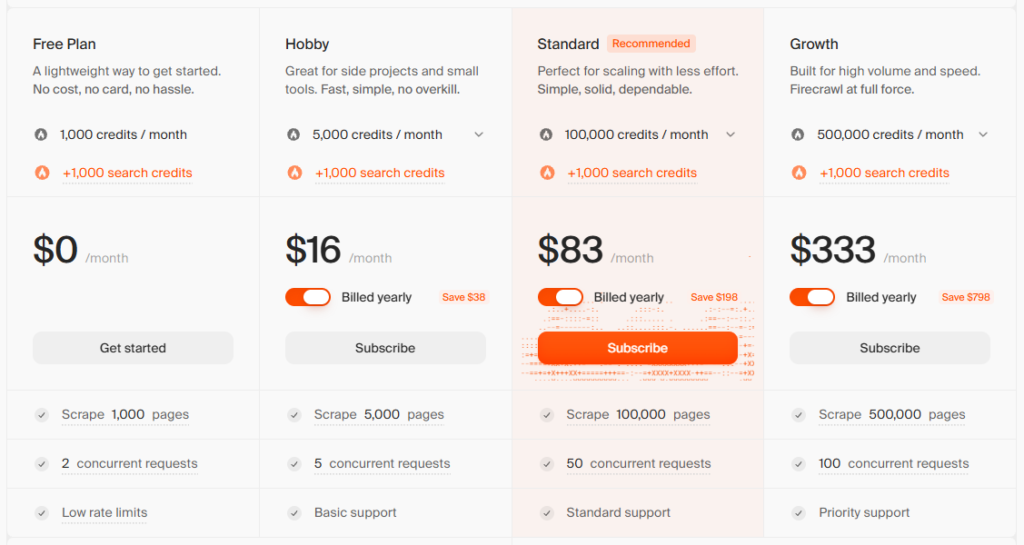
Pricing plays an important role when choosing a web crawling platform. In this Firecrawl Review, the platform offers multiple pricing options designed for individuals, startups, and enterprise teams.
Free Plan
The free plan allows developers to explore the platform before committing to a paid subscription.
It generally includes:
- Limited crawl credits
- Basic API access
- Website crawling
- Markdown output
- Developer documentation
This option works well for testing small AI projects.
Paid Plans
Premium plans provide additional resources including:
- Higher crawl limits
- More API requests
- Faster processing
- Batch crawling
- Larger website support
- Priority infrastructure
- Team collaboration features
Developers building production AI applications often benefit from upgrading to one of the paid plans.
Performance Review
A major focus of this Firecrawl Review is evaluating the platform’s real-world performance.
Crawling Speed
Firecrawl processes websites efficiently, allowing developers to crawl both individual pages and entire websites within a short period. The crawling engine is designed to minimise delays while maintaining reliable extraction quality.
Content Quality
One of Firecrawl’s greatest strengths is the quality of its extracted content. By removing navigation menus, advertisements, scripts, and other unnecessary elements, it delivers clean Markdown and structured JSON that require minimal additional processing.
JavaScript Support
Many modern websites rely on JavaScript to display content dynamically. Firecrawl renders JavaScript before extraction, allowing it to capture information that many traditional web scrapers fail to retrieve.
API Experience
The REST API is well organised and easy to integrate into development workflows. Developers can automate crawling, schedule data collection, and connect Firecrawl with vector databases, AI frameworks, and custom applications.
Developer Experience
The dashboard, documentation, and SDKs are designed with developers in mind. The learning curve is relatively small, making it accessible for both experienced engineers and developers new to AI data pipelines.
Overall, Firecrawl delivers excellent performance for AI-focused web crawling, particularly when building Retrieval-Augmented Generation systems or Large Language Model applications.
Firecrawl Pros and Cons
Every platform has strengths and limitations. This Firecrawl Review examines both.
Pros
- Built specifically for AI applications
- Clean Markdown output
- Structured JSON extraction
- Supports JavaScript-rendered websites
- Excellent for RAG projects
- Developer-friendly API
- Batch crawling support
- Easy integration with modern AI frameworks
- Well-organised documentation
- Simple user interface
Cons
- Advanced features require a paid subscription
- Large crawls can consume credits quickly
- Primarily designed for developers
- Some websites restrict automated crawling
- Requires basic API knowledge for advanced automation
Firecrawl vs Apify
When choosing a web scraping platform, many developers compare Firecrawl and Apify. Although both platforms can collect website data, they are built with different goals in mind. Firecrawl focuses on preparing web content for AI applications, while Apify offers a broader web scraping and automation platform that supports a wide range of use cases.
Purpose
Firecrawl is purpose-built for AI developers who need clean, structured website content for Large Language Models (LLMs) and Retrieval-Augmented Generation (RAG) systems. It automatically removes unnecessary page elements and prepares data in AI-friendly formats.
Apify is a general-purpose web scraping and automation platform. In addition to data extraction, it supports browser automation, workflow automation, monitoring, scheduled tasks, and custom web scraping projects across various industries.
Output Format
One of Firecrawl’s biggest advantages is its AI-ready output. It converts webpages into clean Markdown and structured JSON, making the extracted content easy to index, embed, and use within AI pipelines.
Apify typically returns raw structured data such as HTML, JSON, CSV, XML, or Excel files. While highly flexible, developers often need additional processing to clean and prepare the data before using it in AI applications.
AI Integration
Firecrawl is specifically optimised for AI workflows. It integrates naturally with vector databases, LangChain, LlamaIndex, OpenAI, Anthropic Claude, Google Gemini, and other modern AI frameworks. This reduces development time when building RAG systems, AI assistants, or enterprise knowledge bases.
Apify also supports AI projects, but its primary focus remains web scraping and automation. Developers may need to perform additional data cleaning and transformation before integrating the extracted content into LLM-powered applications.
Ease of Use
For developers building AI applications, Firecrawl often provides a simpler experience because the extracted content is already formatted for AI consumption. Less preprocessing means faster implementation and reduced development effort.
Apify offers greater flexibility and supports thousands of different scraping scenarios. However, users may spend more time configuring actors, automation workflows, and post-processing data depending on the complexity of the project.
Which One Should You Choose?
Choose Firecrawl if your primary goal is building AI-powered applications, RAG pipelines, chatbots, or knowledge bases using clean website content.
Choose Apify if you need a versatile web scraping and automation platform capable of handling large-scale data extraction, browser automation, scheduled workflows, and custom scraping tasks beyond AI applications.
Firecrawl vs Crawl4AI
Another common comparison is between Firecrawl and Crawl4AI. While both platforms support AI-focused web crawling, they differ significantly in deployment, maintenance, and overall developer experience.
Hosting
Firecrawl is a fully managed cloud platform. Developers can start crawling websites immediately without worrying about servers, infrastructure, or deployment.
Crawl4AI is an open-source project that is generally self-hosted. Users install and manage the software on their own infrastructure, giving them complete control over the environment.
Maintenance
With Firecrawl, infrastructure management is handled by the service provider. Updates, scaling, security patches, and system maintenance are managed automatically, allowing developers to focus entirely on building AI applications.
Crawl4AI requires users to maintain their own deployment. This includes installation, updates, server monitoring, troubleshooting, and infrastructure management, making it better suited to technically experienced teams.
Scalability
Firecrawl offers managed scalability for production environments. As crawling requirements grow, users can increase capacity without making significant infrastructure changes.
Crawl4AI also supports large-scale crawling, but scaling typically requires additional server resources, configuration, and ongoing maintenance by the development team.
Flexibility
Firecrawl provides a streamlined experience with built-in features designed specifically for AI workflows. It prioritises simplicity, speed, and managed infrastructure.
Crawl4AI offers greater flexibility because developers have direct access to the underlying system. This makes it easier to customise crawling behaviour, integrate additional tools, and adapt the platform to specialised requirements.
Which One Should You Choose?
Firecrawl is an excellent choice for developers and businesses that want a managed, production-ready web crawling platform with minimal setup and seamless integration into AI workflows.
Crawl4AI is better suited for organisations that prefer open-source software, require complete control over their infrastructure, or need extensive customisation. Teams with the technical expertise to manage self-hosted environments may find Crawl4AI a more flexible long-term solution.
Who Should Use Firecrawl?
Firecrawl is ideal for:
- AI developers
- Software engineers
- Machine learning engineers
- Startup founders
- Data engineers
- Enterprise development teams
- RAG application builders
- AI agent developers
- Technical documentation teams
- Companies building internal knowledge bases
The platform is especially valuable for developers working with modern AI frameworks and vector databases.
Is Firecrawl Worth It?
One of the biggest questions answered in this Firecrawl Review is whether the platform justifies its cost.
For developers building AI-powered applications, the answer is generally yes.
Firecrawl removes one of the biggest challenges in AI development by converting websites into clean, structured data that can be used immediately in Retrieval-Augmented Generation systems and Large Language Model applications.
Its ability to automate website crawling, reduce preprocessing work, and integrate with modern AI workflows makes it a valuable productivity tool for many development teams.
Final Verdict:
This Firecrawl Review shows that the platform is one of the strongest AI-focused web crawling solutions available today. Its clean Markdown output, structured JSON extraction, JavaScript rendering, developer-friendly API, and seamless integration with RAG pipelines make it an excellent choice for modern AI development.
While it may not replace general-purpose web scraping platforms for every project, Firecrawl excels in its specialised role of preparing web content for Large Language Models and Retrieval-Augmented Generation systems. If your goal is to build AI chatbots, enterprise knowledge bases, AI search engines, or other LLM-powered applications, Firecrawl provides a reliable and efficient foundation.
Must Read:
- Endorsely Review: The Best AI Recommendation Letter Generator?
- GUVI Geek Review: The Best Platform to Learn Coding?
- Samwell AI Review: Can It Really Write Better Essays?
FAQs:
What is Firecrawl used for?
Firecrawl is used to crawl websites and convert their content into clean Markdown or structured JSON for AI applications, Retrieval-Augmented Generation systems, chatbots, and Large Language Model projects.
Is Firecrawl suitable for RAG applications?
Yes. Firecrawl is specifically designed to prepare website content for Retrieval-Augmented Generation workflows by extracting clean, structured information that can be indexed in vector databases.
Does Firecrawl support JavaScript websites?
Yes. Firecrawl renders JavaScript before extracting content, allowing it to capture information from modern websites that rely on dynamic page rendering.
Can Firecrawl integrate with AI frameworks?
Yes. Firecrawl works well with popular AI tools and frameworks, including LangChain, LlamaIndex, OpenAI models, Anthropic Claude, Google Gemini, Pinecone, Weaviate, ChromaDB, and other vector database solutions.
Is Firecrawl free to use?
Firecrawl offers a free plan with limited crawl credits and basic features. Paid plans provide higher usage limits, advanced capabilities, and additional resources for larger AI projects.
Who should use Firecrawl?
Firecrawl is ideal for AI developers, software engineers, machine learning professionals, data engineers, startups, enterprise teams, and anyone building applications powered by Large Language Models or Retrieval-Augmented Generation.