The future of AI writing is moving far beyond simply asking a chatbot to write a blog post. In 2026, AI is becoming part of the entire blogging workflow, from topic research and content planning to drafting, editing, SEO optimisation, visual creation, content updates, and search visibility.
For bloggers, this creates a major opportunity. AI can reduce repetitive work and help one person manage a content operation that previously required several people. At the same time, the growing amount of AI-generated content means generic articles are becoming easier to produce and harder to differentiate.
The future of AI writing will therefore not belong simply to bloggers who publish the most content. It will favour bloggers who know how to combine AI efficiency with human expertise, original research, personal experience, strong editing, and a distinctive point of view.
Google’s current guidance supports this direction. Google says generative AI can be useful for research and adding structure to original content, but generating many pages without adding value can violate its scaled-content-abuse policy.
Understanding The Future of AI Writing means understanding both sides of this change: what AI can automate and what human writers still need to contribute.
How AI Writing Has Changed Blogging
AI writing has already changed the way bloggers approach content creation. Instead of starting with a blank document, writers can use AI to generate ideas, organise research, build outlines, create drafts, rewrite sections, and develop multiple content formats in a fraction of the traditional time.
Recent 2026 discussions around AI writing tools show that the strongest blogging workflows increasingly use AI across multiple stages rather than relying on a single “one-click article generator”. Research, outlining, drafting, SEO, editing, and visual creation are increasingly being connected into one workflow.
From Article Generator to Writing Assistant
Early AI writing tools were mainly designed to generate paragraphs.
Modern AI writing tools can do much more.
A blogger can now use AI to:
- Brainstorm topics
- Analyse a content idea
- Generate questions
- Create outlines
- Summarise research
- Draft sections
- Rewrite paragraphs
- Improve readability
- Adjust tone
- Create SEO metadata
- Generate FAQs
- Suggest internal links
- Repurpose content
- Create social media posts
- Help analyse content performance
This changes the role of the blogger.
Instead of spending most of the day typing, bloggers can spend more time making decisions about what should be published and why.
AI Is Becoming Part of the Content Workflow
The future of AI writing is increasingly about workflows rather than individual prompts.
A typical workflow might look like:
Topic research → Search intent → Research → Outline → AI draft → Human expertise → Editing → SEO → Visuals → Publishing → Updating
This approach is more useful than simply asking AI to “write a 2,000-word article”.
The blogger remains responsible for the strategy while AI handles many repetitive tasks.
AI Will Not Make Every Blogger a Better Writer
One important point about The Future of AI Writing is that easier content creation does not automatically mean better content.
AI can help someone produce an article quickly, but speed does not guarantee originality, accuracy, or usefulness.
A weak idea can become a weak article even when AI writes it beautifully.
The Quality Gap Will Become More Important
As AI writing becomes more accessible, the cost of producing average content will continue to fall.
That means generic content becomes less valuable.
If thousands of websites can create an article explaining “What is AI writing?” in seconds, simply publishing another basic explanation does not give your website much of an advantage.
The difference will come from:
- Experience
- Original research
- Strong opinions
- Unique examples
- Expert analysis
- Testing
- Case studies
- Better explanations
- Better storytelling
- Useful visuals
AI can generate information.
Your advantage is what you know and how you use that information.
Human Expertise Will Become More Valuable
The future of AI writing does not mean the end of human writers. Instead, human expertise is likely to become more important as AI-generated information becomes abundant.
Google’s people-first content guidance asks whether content provides original information, research, analysis, or substantial additional value rather than simply summarising what other websites already say.
Experience Is Difficult to Automate
Suppose you write about an AI website builder.
AI can explain its features.
But if you actually used the platform, you can explain:
- How long setup took
- How good the generated design was
- What happened on mobile
- Which SEO controls were available
- Where the editor was confusing
- What features were missing
- Who should use it
- Who should avoid it
That information is much more valuable than a generic feature list.
Personal Perspective Creates Differentiation
Your experience, judgement, and perspective can become your competitive advantage.
Two bloggers can use the same AI tool and produce completely different articles because their expertise and opinions are different.
That is one reason human input will remain important.
AI Will Help Bloggers Research Faster
Research is one area where AI can provide significant benefits.
Instead of manually opening dozens of pages to understand a topic, bloggers can use AI to organise questions, identify subtopics, summarise documents, and create research frameworks.
AI Can Identify Questions Readers Ask
Suppose your main topic is:
The Future of AI Writing
AI can help identify related questions:
- Will AI replace bloggers?
- Will AI-generated content rank on Google?
- How will SEO change?
- What skills will bloggers need?
- Will AI reduce writing jobs?
- How can bloggers stay competitive?
- Will AI search reduce website traffic?
- What types of content will remain valuable?
These questions can become sections in a comprehensive article.
Human Verification Still Matters
AI research should not replace source verification.
Important facts should be checked against reliable sources, particularly when discussing:
- Google policies
- Statistics
- Current AI tools
- Pricing
- Technology features
- Legal issues
- Research findings
- Industry developments
Google’s guidance specifically recommends focusing on accuracy, quality, and relevance when using generative AI for web content.
AI Search Will Change How Bloggers Write
One of the biggest developments affecting The Future of AI Writing is the growth of AI-powered search.
Google’s AI Overviews and AI Mode are changing how users interact with Search. Google’s current guidance says users are asking longer, more specific questions and using follow-up questions to explore topics.
This means bloggers need to think beyond individual keywords.
Search Intent Will Matter More
Traditional SEO often focused heavily on phrases such as:
“best AI writing tools”
AI-powered search encourages more conversational questions such as:
“Which AI writing tool is best for a blogger who publishes long-form SEO articles every week?”
The second query reveals more context.
Good content needs to address that context.
Answer Questions Clearly
Make the answer easy to find.
For example:
Can AI replace bloggers?
A strong answer might begin:
“AI is unlikely to replace every blogger, but it will automate many repetitive parts of blogging. Bloggers who provide expertise, original research, personal experience, and strong editorial judgement will remain valuable.”
Then explain the reasoning.
This format helps both readers and AI-powered search systems understand the topic.
Original Content Will Become More Important
As AI makes content creation easier, originality becomes more valuable.
This is one of the most important lessons about The Future of AI Writing.
If AI can generate a basic article on almost any subject, then basic information becomes less of a competitive advantage.
Create Content AI Cannot Easily Reproduce
Consider adding:
- Original surveys
- Product tests
- Expert interviews
- Case studies
- Screenshots
- Experiments
- First-hand reviews
- Data analysis
- Unique comparisons
- Personal observations
These elements give readers something beyond a generic summary.
Google’s guidance for AI search specifically recommends unique, non-commodity content that provides value to visitors.
Build Your Own Data
A blogger can create original research without being a large company.
For example, you could survey 100 bloggers about:
- How often they use AI
- Which AI tools they use
- How much time AI saves
- How they edit AI drafts
- Whether they use AI for SEO
- What problems they experience
You can then publish the results.
That becomes original information associated with your website.
AI Will Change the Role of SEO
SEO will remain important, but the workflow is changing.
Google’s 2026 documentation continues to emphasise that SEO best practices remain relevant for generative AI features in Search. Its current guidance also highlights non-commodity content and discusses AI search features such as AI Overviews and AI Mode.
Keywords Will Still Matter
Keywords are not disappearing.
People still use words and phrases to find information.
But bloggers should focus on topics and intent rather than forcing exact keywords into every paragraph.
For example, an article targeting AI writing for bloggers might naturally cover:
- AI blog writing
- AI content creation
- AI writing tools
- AI-assisted blogging
- SEO content
- AI-generated articles
- human editing
- content optimisation
The goal is natural topical coverage.
Topical Authority Will Matter
A website that covers one subject deeply can become more useful than a website publishing random AI-generated articles across dozens of unrelated topics.
For example, an AI website could build a content cluster around:
- AI website builders
- AI web design
- AI content writing
- AI SEO
- AI blogging
- AI content editing
- Google AI Overviews
- AI writing tools
Each article supports the others.
AI Will Make Content Updating Easier
Blogging is not only about creating new articles.
Older content often needs updates.
AI can help identify sections that may need attention.
Use AI to Audit Existing Articles
You can ask AI to review an old article and identify:
- Outdated sections
- Repeated information
- Weak introductions
- Missing questions
- Broken logic
- Poor readability
- Internal linking opportunities
- Sections requiring new research
Then verify and update the information manually.
Refresh Content With Real Changes
Do not simply change the publication date.
Update:
- Statistics
- Product information
- Examples
- Screenshots
- Links
- Recommendations
- SEO information
- Industry developments
The result should be a genuinely improved article.
AI Will Help Bloggers Repurpose Content

A single high-quality article can become many content formats.
For example, a 2,500-word blog post can be transformed into:
- LinkedIn posts
- Instagram captions
- Facebook posts
- Email newsletters
- Short video scripts
- YouTube scripts
- Pinterest descriptions
- FAQs
- Quotes
- Social media carousel copy
AI can speed up this process.
One Idea Can Become Multiple Assets
Suppose you publish an article about AI writing.
AI could help turn it into:
Blog post: The Future of AI Writing
Newsletter: 5 changes bloggers should prepare for
LinkedIn post: Why human expertise matters more in the AI era
Short video: Will AI replace bloggers?
Social carousel: 7 AI writing trends for 2026
This increases the value of every research project.
AI Will Make Visual Content More Important
Text is only one part of blogging.
AI image generation and design tools are making visual content faster to produce.
Bloggers can create:
- Feature images
- Infographics
- Diagrams
- Comparison graphics
- Social media images
- Illustrations
- Process charts
Use Visuals to Add Information
Do not create images simply because an article needs an image.
A useful graphic can explain a concept faster than several paragraphs.
For example, an AI writing workflow could be shown as:
Research → AI Assistance → Human Expertise → Editing → SEO → Publishing
That visual gives the reader an immediate overview.
Google’s AI search guidance also points to the importance of different content formats, including local, shopping, image, and video content, as Search becomes more multimodal.
AI Will Increase the Importance of Brand Voice
When thousands of websites use similar AI models, writing styles can start to look similar.
This creates a problem for bloggers.
If every article uses the same phrases, sentence patterns, and generic introductions, readers have little reason to remember one website over another.
Develop a Recognisable Voice
Your brand voice can come from:
- Vocabulary
- Sentence style
- Opinions
- Examples
- Storytelling
- Humour
- Expertise
- Formatting
- Editorial standards
AI can follow a style guide, but you need to define what that style should be.
Give AI Examples of Your Writing
One practical approach is to provide AI with several examples of your previous articles.
Explain:
- What you like about the style
- What should be avoided
- How formal the writing should be
- How long paragraphs should be
- How headings should work
- How technical terms should be explained
Then review the output carefully.
The goal is consistency, not making every article sound identical.
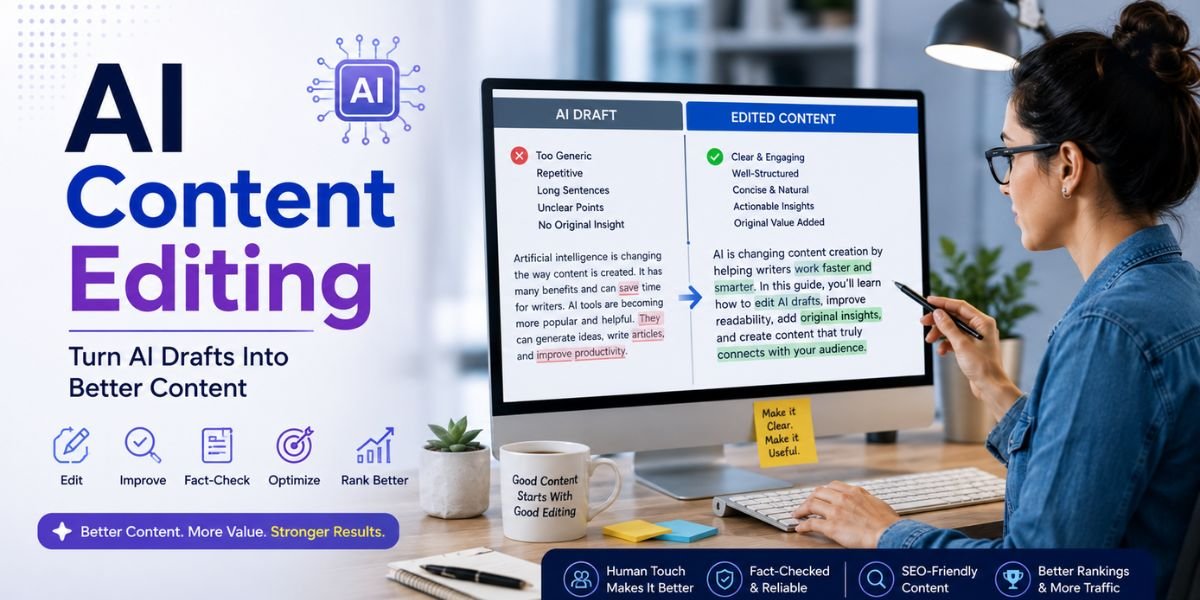
AI Will Make Editing More Important
The future of AI writing is not only about generating drafts.
Editing may become one of the most important parts of the workflow.
Recent 2026 AI writing discussions increasingly emphasise human editing, fact-checking, and unique perspective as the elements that separate useful AI-assisted content from generic output.
AI Drafts Need Human Review
AI-generated drafts can contain:
- Incorrect facts
- Repetition
- Generic statements
- Weak examples
- Missing context
- Outdated information
A human editor can identify problems that a simple grammar check cannot.
Use AI as a Second Editor
AI can also review content after you edit it.
For example, ask:
“Identify sections that repeat the same idea.”
Or:
“Find claims that should be fact-checked.”
Or:
“Which sections do not fully answer the reader’s question?”
You then decide whether the suggestions are useful.
This creates a workflow where humans and AI review each other.
Bloggers Will Need New Skills

As AI handles more repetitive writing tasks, the skills that matter most to bloggers will change.
Research Skills
Bloggers need to know how to find reliable information.
Editorial Skills
You need to know what information belongs in an article and what should be removed.
Fact-Checking
AI can make mistakes, so verification is essential.
SEO Strategy
Understanding search intent, internal links, topical relevance, and content structure remains valuable.
Prompting
Good instructions can make AI much more useful.
Data Analysis
The ability to interpret traffic, conversions, engagement, and content performance can improve decisions.
Storytelling
Human stories and experiences remain difficult to replace with generic AI output.
Subject Expertise
The more you know about your niche, the more effectively you can guide AI.
AI Will Not Eliminate the Need for Bloggers
The question “Will AI replace bloggers?” is likely to become less useful than another question:
“Which parts of blogging will AI replace?”
AI can automate many repetitive activities.
But blogging also involves:
- Choosing a point of view
- Building trust
- Understanding an audience
- Testing products
- Developing relationships
- Interviewing people
- Sharing experiences
- Making recommendations
- Building a personal brand
These activities require judgement and context.
The Blogger’s Role Will Change
The future blogger may spend less time writing every sentence from scratch.
Instead, they may spend more time:
- Researching
- Editing
- Testing
- Analysing
- Interviewing
- Planning
- Building a community
- Creating original ideas
This is not necessarily a reduction in the value of writing.
It is a change in where the value is created.
AI Will Make Content Competition Stronger
Another major trend in The Future of AI Writing is increased competition.
If AI reduces the time required to create content, more websites will publish more articles.
That means publishing frequently will not necessarily be enough.
Quantity Alone Will Not Be a Competitive Advantage
Imagine two websites.
Website A publishes 100 generic AI articles every month.
Website B publishes 15 carefully researched articles with original data, testing, examples, and expert analysis.
Website B may have fewer pages, but each page can provide significantly more value.
Google’s people-first guidance specifically warns against producing lots of content on many topics simply because it seems likely to attract search traffic.
Build a Reason for Readers to Return
A successful blog needs more than search traffic.
Give readers reasons to remember your website.
That might be:
- Unique research
- Excellent reviews
- Practical tutorials
- Strong opinions
- Helpful tools
- Original data
- Consistent expertise
AI Agents Could Change Blogging Workflows
The next phase of AI writing may involve more autonomous AI agents.
Google’s 2026 search guidance already includes initial information about AI agents in its guidance around generative AI features.
An AI agent can potentially handle several connected tasks rather than responding to one prompt at a time.
What Could an AI Content Agent Do?
A future content workflow could involve an agent that:
- Identifies content opportunities
- Researches the topic
- Collects sources
- Builds an outline
- Creates a draft
- Checks for missing information
- Suggests internal links
- Creates metadata
- Produces visual concepts
- Sends the article to a human editor
The human still needs to supervise the process.
Human Approval Will Remain Important
Fully automated publishing may be attractive because of its speed, but quality control becomes more important as automation increases.
A human editor should be able to stop publication when:
- Sources are weak
- Facts cannot be verified
- The topic is misunderstood
- The content is generic
- The recommendation is questionable
- The article lacks original value
Automation should increase efficiency without removing responsibility.
AI Content and Trust Will Become Connected
As AI-generated content becomes more common, readers may become more interested in knowing who created information and whether the author has genuine expertise.
Google’s guidance says providing context about how content was created can help readers when that information would reasonably matter to them.
Author Expertise Matters
Consider adding:
- Author biographies
- Relevant qualifications
- Experience
- Editorial policies
- Testing methodology
- Sources
- Review dates
- Update information
These details can help readers understand why they should trust the content.
Be Transparent About AI Assistance
There is no universal need to add a large AI disclaimer to every article.
But when AI substantially contributes to the creation of content, consider whether readers would benefit from knowing how the article was produced.
The focus should remain on accuracy and usefulness.
Bloggers Should Build AI-Assisted Content Systems
The future of AI writing is moving toward systems rather than isolated tools.
Instead of using one application for everything, bloggers may combine several specialised tools.
A Modern AI Blogging Stack
A practical workflow could include:
Research: AI research assistant and reliable sources
Planning: AI outlining tool
Writing: General-purpose AI assistant
SEO: SEO analysis platform
Editing: Grammar and style tools
Visuals: AI image or design tool
Analytics: Search and website analytics
Human review: Final editorial control
Current 2026 tool comparisons increasingly describe blogging as a multi-stage AI workflow involving research, outlining, drafting, SEO, editing, visual creation, and distribution.
Choose Tools Based on Your Workflow
You do not need every AI tool available.
Choose tools that solve actual problems.
A solo blogger may need only:
- One strong AI assistant
- One SEO tool
- One editing tool
- One design tool
A larger publishing team may require a more sophisticated system.
How Bloggers Can Prepare for the Future
You do not need to completely rebuild your website because AI is changing.
Start by improving your existing process.
Step 1: Learn AI-Assisted Research
Use AI to identify questions and research directions.
Step 2: Improve Your Prompts
Give AI detailed context about your audience and goals.
Step 3: Create Better Outlines
Plan articles before generating drafts.
Step 4: Add Original Information
Use your experience, research, testing, and analysis.
Step 5: Strengthen Editing
Never publish important content without review.
Step 6: Improve SEO
Focus on search intent and useful topic coverage rather than keyword repetition.
Step 7: Build Your Brand
Develop a recognisable voice and perspective.
Step 8: Create Original Visuals
Use images, diagrams, screenshots, and data visualisations where they add value.
Step 9: Monitor Search Changes
Google’s AI search features continue to evolve, so keep your SEO knowledge current. Google’s documentation updates now include dedicated guidance around generative AI features and AI search.
Step 10: Keep the Human in Control
AI should support your decisions rather than replace editorial responsibility.
Common Mistakes Bloggers Should Avoid
AI makes some mistakes easier to repeat at scale.
Avoid these common problems.
Publishing Raw AI Drafts
A first draft is not a finished article.
Creating Generic Content
If your article says exactly what every other website says, there is little reason to choose it.
Chasing Word Count
More words do not automatically create better content.
Ignoring Original Research
Your own research can become one of your strongest competitive advantages.
Using AI for Fake Expertise
Never invent experience, testing, interviews, or research.
Publishing Too Much
More content is not always better.
Ignoring Readers
Do not create articles only because a keyword has search volume.
Google recommends people-first content rather than content created primarily to manipulate search rankings.
The Future of AI Writing for Bloggers
The future of AI writing will probably not be a simple competition between humans and machines.
It will be a combination of both.
AI will become better at:
- Drafting
- Research assistance
- Summarisation
- Editing
- Content transformation
- Personalisation
- SEO assistance
- Workflow automation
- Data analysis
Humans will remain important for:
- Original ideas
- Experience
- Judgement
- Creativity
- Trust
- Editorial decisions
- Relationships
- Expertise
The strongest bloggers will learn how to combine these capabilities.
The Best Bloggers Will Become Better Editors and Strategists
When AI handles more basic writing, the blogger’s value shifts.
Instead of asking:
“How fast can I write?”
you may ask:
“How valuable is this idea?”
Instead of:
“How many articles can I publish?”
you may ask:
“What unique information can I provide?”
Instead of:
“Can AI write this article?”
you may ask:
“What should only I contribute?”
Those questions will shape successful blogging strategies in the coming years.
Must Read:
- How to Create Original Content With AI?
- AI Content Editing: Turn AI Drafts Into Better Content
- How to Create High-Quality Blog Content With AI?
Final Thoughts:
The future of AI writing is not simply about machines producing more words. It is about changing how bloggers research, plan, create, edit, optimise, and distribute content.
AI will make many parts of blogging faster. It will help generate ideas, organise research, create outlines, draft sections, edit language, update old articles, and repurpose content. It may also become increasingly capable of handling connected workflows through more autonomous AI agents.