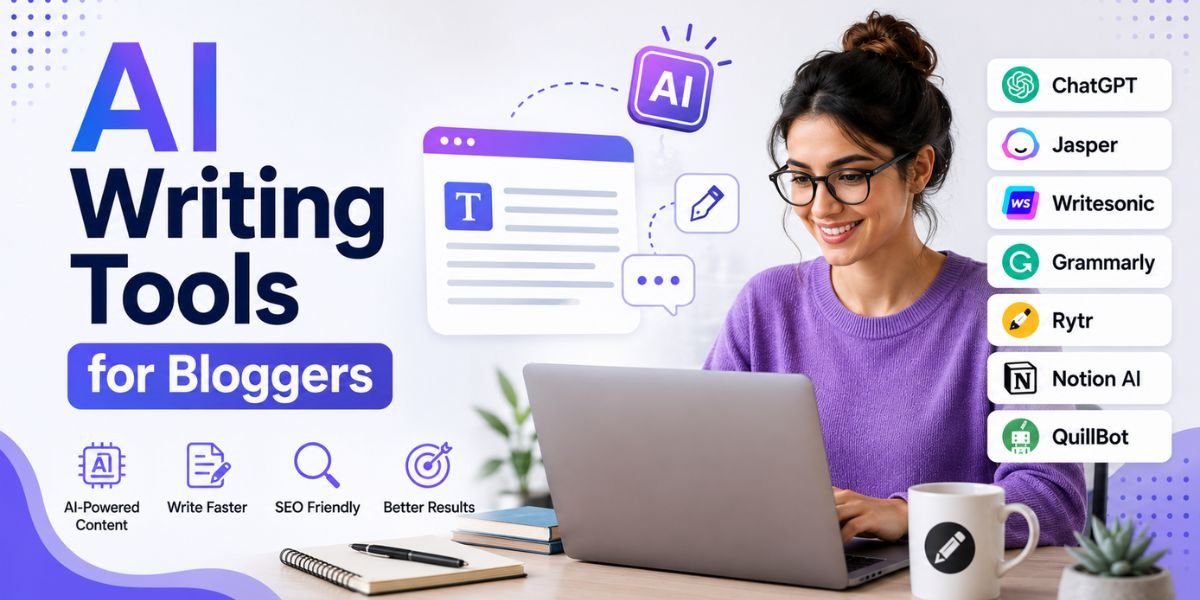
Finding the Best AI Writing Tools for Bloggers can save hours of research, drafting, editing, and content optimisation. But not every AI writing tool is designed for the same job. Some are better for long-form blog writing, some focus on SEO, others are excellent for editing, and a few are designed around brand voice and content teams.
In 2026, the AI writing market has also changed significantly. General-purpose assistants such as ChatGPT and Claude compete with specialist platforms such as Jasper and Writesonic, while tools such as Grammarly, Notion AI, and Surfer focus on editing, workflow, and content optimisation. Recent 2026 comparisons also show that dedicated tools increasingly differentiate themselves through SEO workflows, brand voice, research, and AI-search visibility rather than simple text generation.
For bloggers, the best choice depends on what you actually need. A solo blogger who publishes a few detailed articles each month may prefer a general AI assistant, while an SEO-focused publisher or content team may benefit more from a specialist platform.
What Are AI Writing Tools for Bloggers?
Best AI Writing Tools for Bloggers are software applications that use artificial intelligence to help create, improve, organise, or optimise written content. They can assist with blog outlines, introductions, complete drafts, headlines, rewriting, grammar, SEO optimisation, summaries, content research, and repurposing.
The biggest benefit is not simply generating an article automatically. Good AI writing tools can help reduce the time spent on repetitive tasks while allowing the blogger to concentrate on research, expertise, originality, and final editing.
How AI Writing Tools Help Bloggers
A blogger can use AI during almost every stage of content production.
For example, AI can help you:
- Generate new blog ideas
- Analyse a topic
- Create content outlines
- Find related questions
- Write a first draft
- Improve introductions
- Rewrite difficult sentences
- Create meta descriptions
- Generate FAQs
- Improve readability
- Repurpose articles
- Create social media posts
- Edit grammar
- Develop content briefs
- Optimise content for search
OpenAI’s current writing guidance describes ChatGPT as useful for drafting, rewriting, tightening, adjusting tone, and turning rough notes into clearer communication. OpenAI also recommends treating the output as a draft that should be reviewed rather than as a final authority.
AI Should Assist, Not Replace the Blogger
AI can make writing faster, but it does not automatically make an article valuable.
A strong blog post still needs human judgement, fact-checking, original examples, useful research, and a clear understanding of the audience.
This is especially important for SEO. Google says generative AI can be useful for research and structuring original content, but generating many pages without adding value can fall under its scaled-content-abuse policies.
The best workflow is therefore:
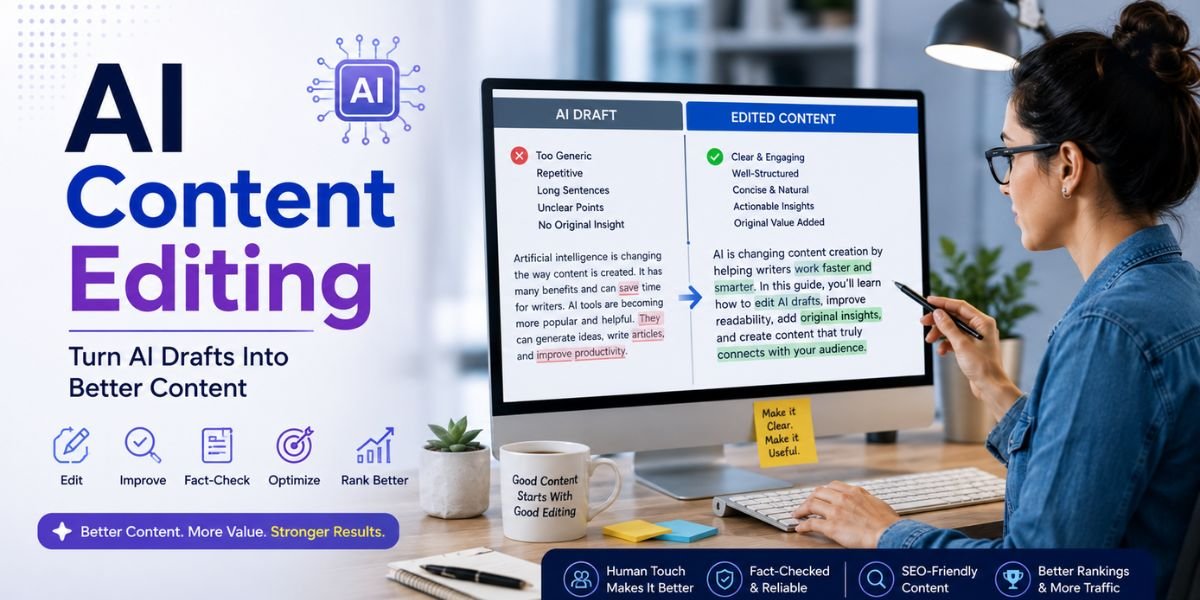
Research → Plan → AI assistance → Human editing → Fact-check → SEO optimisation → Publish
How We Chose the Best AI Writing Tools
There is no single AI writing tool that is perfect for every blogger. For this list of the Best AI Writing Tools for Bloggers, the tools are compared based on the features that matter most to people creating regular blog content.
The main factors include writing quality, long-form performance, SEO support, editing features, ease of use, research capabilities, workflow, flexibility, and suitability for individual bloggers or teams.
Recent 2026 comparisons similarly evaluate tools based on factors such as long-form coherence, SEO features, ease of use, brand voice, and pricing.
What Bloggers Should Look For
Before choosing an AI writing tool, consider:
- Quality of generated content
- Long-form writing ability
- Content editing
- SEO features
- Research support
- Brand voice
- Ease of use
- Integrations
- Content workflow
- Pricing
- Free or trial access
- Ability to handle your niche
A tool that is excellent for social media may not be the right choice for publishing 3,000-word SEO articles.
1. ChatGPT
ChatGPT is one of the most flexible options in the Best AI Writing Tools for Bloggers category because it can support everything from brainstorming and research assistance to outlining, drafting, editing, and content repurposing.
OpenAI’s current writing guidance specifically positions ChatGPT as a writing assistant for planning, drafting, revising, and packaging content for different formats.
Why Bloggers Should Consider ChatGPT
ChatGPT is particularly useful when you want one flexible tool rather than a specialised content platform.
You can use it to:
- Brainstorm blog topics
- Create detailed outlines
- Develop article introductions
- Rewrite sections
- Improve readability
- Create FAQs
- Generate social media content
- Repurpose existing articles
- Review your content structure
- Adapt writing for different audiences
One of its biggest advantages is flexibility. You can give it detailed instructions about your audience, tone, structure, keywords, and content requirements.
Best For
Best for: Solo bloggers, general content creation, brainstorming, editing, and flexible writing workflows.
Potential Limitation
Because ChatGPT is a general-purpose assistant, you may need additional SEO tools for advanced keyword analysis, SERP analysis, and content scoring.
2. Claude
Claude is another strong option for bloggers who prioritise natural long-form writing, content organisation, and detailed editing.
Current 2026 comparisons frequently place Claude among the strongest general AI writing assistants, particularly for long-form writing quality and value.
Why Bloggers Should Consider Claude
Claude can be useful when your articles require a consistent structure and detailed explanations.
It can help with:
- Long-form drafts
- Content outlines
- Rewriting
- Editing
- Summaries
- Research assistance
- Tone adjustment
- Content analysis
For bloggers writing tutorials, guides, educational articles, and detailed explainers, a general-purpose tool such as Claude can be particularly useful.
Best For
Best for: Long-form articles, educational content, editing, and writers who prefer a natural writing style.
Potential Limitation
Like other general AI assistants, Claude is not a complete replacement for dedicated SEO platforms.
3. Jasper

Jasper is one of the more specialised platforms in the Best AI Writing Tools for Bloggers space, particularly for marketing teams and publishers that need consistent brand voice.
Recent 2026 comparisons identify Jasper as particularly strong for brand-controlled marketing content and teams producing content at scale.
Why Bloggers Should Consider Jasper
Jasper is more focused on marketing workflows than a basic chatbot.
It can be useful for:
- Blog content
- Marketing copy
- Brand voice
- Campaign content
- Content templates
- Team workflows
- Social media copy
- Website content
If your blog is part of a larger business marketing strategy, brand consistency can be extremely important.
Best For
Best for: Marketing teams, professional publishers, agencies, and businesses with strict brand voice requirements.
Potential Limitation
Jasper may be more than a solo blogger needs if you only want occasional article drafting.
4. Writesonic
Writesonic is a strong choice for bloggers who want AI writing combined with SEO and AI-search-focused features.
Current 2026 reviews describe Writesonic as increasingly focused on SEO and AI-search visibility rather than being only a basic writing application.
Why Bloggers Should Consider Writesonic
Writesonic can be useful for bloggers who want a more structured content workflow.
Depending on the workflow, it can help with:
- Blog article generation
- SEO content
- Content optimisation
- Article research
- AI-search visibility
- Content rewriting
- Marketing content
This makes it particularly interesting for publishers who care about organic search performance.
Best For
Best for: SEO-focused bloggers, affiliate publishers, content marketers, and website owners interested in AI-search visibility.
Potential Limitation
If you already use a separate SEO platform and only need a writing assistant, you may not need all of its additional features.
5. Grammarly
Grammarly is different from many tools on this list because its biggest strength is improving and polishing existing writing.
It is especially useful after you have created your blog draft.
Why Bloggers Should Consider Grammarly
A blogger can use Grammarly to improve:
- Grammar
- Spelling
- Sentence clarity
- Tone
- Readability
- Word choice
- Conciseness
- Overall writing quality
This makes it a useful final-stage tool.
Instead of asking AI to create the entire article, you can write the article yourself or generate a first draft with another tool and then use Grammarly to improve the finished content.
Best For
Best for: Editing, proofreading, polishing, and bloggers who want cleaner writing.
Potential Limitation
Grammarly is not primarily a full SEO content research platform, so you may need another tool for keyword research and detailed search optimisation.
6. Rytr
Rytr remains a practical option for bloggers looking for a simpler and more budget-friendly AI writing tool.
Recent 2026 comparisons continue to position Rytr as a lower-cost option, particularly for shorter content and straightforward writing tasks.
Why Bloggers Should Consider Rytr
Rytr can help with:
- Blog ideas
- Short blog sections
- Introductions
- Product descriptions
- Social posts
- Emails
- Ad copy
- Rewriting
Its simpler workflow can make it attractive to new bloggers who do not need a large marketing platform.
Best For
Best for: Beginners, budget-conscious bloggers, short-form writing, and simple content tasks.
Potential Limitation
For large, research-heavy, long-form articles, a more powerful general AI assistant or dedicated long-form platform may be preferable.
7. Notion AI

Notion AI is a particularly interesting option for bloggers who already use Notion to organise their content.
Rather than functioning only as an AI writing application, Notion AI works inside the Notion workspace and can help create and edit pages, search connected information, summarise content, and support writing workflows.
Why Bloggers Should Consider Notion AI
If your blog workflow already lives in Notion, you can keep your ideas, research, content calendar, outlines, drafts, and AI assistance in one environment.
Notion says its AI tools can improve existing content, generate new text, summarise pages, and work with context from your workspace and connected applications.
This can reduce the need to move between several different applications.
Best For
Best for: Bloggers who use Notion for content planning, research, project management, and writing.
Potential Limitation
Notion AI is most useful when you already like the Notion workspace. It may not be the first choice if you want a dedicated SEO content platform.
8. QuillBot
QuillBot is particularly useful for rewriting, paraphrasing, summarising, and improving existing content.
For bloggers, this makes it a useful companion rather than necessarily the only AI writing tool they need.
Why Bloggers Should Consider QuillBot
QuillBot can help when you already have content but want to improve or transform it.
Potential uses include:
- Rewriting paragraphs
- Improving sentence structure
- Summarising research
- Simplifying explanations
- Paraphrasing content
- Improving clarity
- Editing drafts
This can be useful when updating older blog posts or turning research notes into readable content.
Best For
Best for: Rewriting, paraphrasing, summarising, and editing existing blog content.
Potential Limitation
Bloggers who need advanced SEO research and full content planning may need to combine QuillBot with another platform.
9. Surfer
Surfer is particularly relevant to SEO-focused bloggers because it approaches content creation from a search optimisation perspective.
Recent 2026 reviews describe Surfer as a content editor that focuses on SEO and AI-search visibility within the writing workflow.
Why Bloggers Should Consider Surfer
Surfer can be useful for bloggers who want to understand how their content compares with pages already performing in search.
It can support:
- Content optimisation
- Keyword and topic coverage
- SEO-focused editing
- Content planning
- AI-assisted writing
- Search-focused workflows
This makes it different from a general chatbot.
Instead of simply asking an AI to write an article, you can build a more SEO-focused content workflow.
Best For
Best for: SEO bloggers, affiliate marketers, content teams, and publishers focused heavily on organic search.
Potential Limitation
Surfer can be more specialised than necessary for bloggers who only want help generating ideas and drafts.
10. Anyword
Anyword is another useful option for marketers and bloggers who want AI-assisted writing with an emphasis on marketing performance and audience-focused copy.
It can be particularly useful when your blog is closely connected to a marketing campaign.
Why Bloggers Should Consider Anyword
Anyword can help with different forms of marketing content, including:
- Blog content
- Advertisements
- Social media copy
- Website copy
- Email content
- Marketing messages
- Content variations
The main attraction is the ability to adapt messaging for different marketing purposes rather than focusing only on generic article generation.
Best For
Best for: Content marketers, businesses, marketing teams, and bloggers who create content alongside promotional campaigns.
Potential Limitation
Solo bloggers looking only for straightforward blog drafting may prefer a general AI assistant.
Best AI Writing Tools for Different Blogging Needs
The Best AI Writing Tools for Bloggers depend heavily on your workflow.
There is no need to subscribe to every tool on this list.
A better strategy is to identify your biggest content problem and choose a tool that solves it.
| Tool | Best For | Main Strength |
|---|---|---|
| ChatGPT | General blogging | Flexible writing and editing |
| Claude | Long-form content | Natural long-form writing |
| Jasper | Marketing teams | Brand voice and marketing |
| Writesonic | SEO blogging | SEO and AI-search workflows |
| Grammarly | Editing | Grammar and writing polish |
| Rytr | Beginners | Simple, budget-friendly writing |
| Notion AI | Content planning | Writing inside a workspace |
| QuillBot | Rewriting | Paraphrasing and summaries |
| Surfer | SEO content | Content optimisation |
| Anyword | Marketing content | Performance-focused copy |
Which AI Writing Tool Is Best for SEO Bloggers?
For SEO-focused bloggers, the strongest choices are generally tools that combine writing assistance with content optimisation.
Surfer and Writesonic are particularly relevant because their workflows are built around SEO and search visibility. Current 2026 comparisons also distinguish specialist platforms from general AI assistants by their SEO and AI-search features.
However, you do not necessarily need an expensive all-in-one platform.
A simple combination can work very well:
ChatGPT or Claude + an SEO research tool + Grammarly
The AI assistant handles brainstorming, outlines, drafts, and revisions. The SEO platform handles keyword and search analysis. Grammarly helps polish the final article.
Which AI Writing Tool Is Best for Beginners?
For beginners, simplicity is often more important than having dozens of advanced features.
ChatGPT is a strong starting point because it can support many writing tasks without requiring a complicated content workflow. OpenAI’s current writing guidance recommends giving the tool context and constraints and treating the output as a draft that should be reviewed.
Rytr can also be useful for beginners who prefer a more focused writing platform.
Notion AI is another option if the blogger already uses Notion to organise content.
Which AI Writing Tool Is Best for Long-Form Blogging?

For long-form blogging, ChatGPT and Claude are strong general-purpose choices, while specialist platforms such as Jasper and Writesonic can be useful when you need a more structured marketing or SEO workflow.
Recent 2026 comparisons commonly place ChatGPT and Claude among the strongest general writing assistants, while Jasper is more specialised for marketing teams and Writesonic has moved further towards SEO and AI-search workflows.
The important thing is not simply which tool produces the most words.
The important question is which tool helps you create the best final article.
Should Bloggers Use AI to Write Entire Articles?
AI can help draft entire articles, but bloggers should not assume that an AI-generated article is automatically ready for publication.
The better approach is to use AI throughout the writing process while keeping human control over the final result.
A Better Blogging Workflow
Start with keyword research.
Then identify search intent.
Create a content outline.
Use AI to develop a first draft.
Add your own research and examples.
Verify important information.
Edit the writing.
Optimise the article for SEO.
Add internal links.
Create useful images.
Review the final article.
This workflow gives you the speed of AI without sacrificing the quality that makes a blog worth reading.
How to Use AI Writing Tools Without Hurting SEO
Using AI does not automatically create an SEO problem.
Google’s guidance says AI can be useful for research and content structure, but producing large quantities of pages without adding value can violate its scaled-content-abuse policy.
Add Original Value
Do not simply ask an AI tool to rewrite the top-ranking pages.
Add:
- First-hand experience
- Original research
- Product testing
- Screenshots
- Examples
- Expert insights
- Unique comparisons
- Case studies
Fact-Check AI Output
AI tools can generate incorrect or outdated information.
Always verify important facts before publication.
Avoid Keyword Stuffing
Use your focus keyword naturally.
Include related terms where they make sense.
Edit the Final Article
AI-generated text can sound repetitive or generic.
Human editing makes the article more useful and distinctive.
How Many AI Writing Tools Does a Blogger Need?
Most bloggers do not need ten AI writing tools.
In many cases, one general AI assistant combined with one editing or SEO tool is enough.
For example:
Beginner: ChatGPT + Grammarly
SEO blogger: ChatGPT + Surfer
Content marketer: Jasper + Grammarly
Notion user: Notion AI + SEO tool
Budget blogger: Rytr + free SEO resources
SEO-focused publisher: Writesonic + dedicated SEO research
The best setup depends on your publishing volume, budget, technical skills, and content goals.
Are AI Writing Tools Worth Paying For?
For frequent bloggers, paid AI writing tools can be worthwhile if they genuinely save time or improve content quality.
However, do not subscribe simply because a tool claims to be an “AI writer”.
Before paying, ask:
- Does it save me time?
- Is the writing better?
- Does it fit my workflow?
- Does it provide features I actually need?
- Does it help with SEO?
- Does it handle long-form content well?
- Can I test it before committing?
- Will I use it every week?
A $20 tool that you use every day can be more valuable than a $100 platform that you barely open.
Must Read:
- How to Write for Google AI Overviews in 2026?
- How to Use AI for Blog Writing Without SEO Problems?
- How to Humanize AI Content Without Losing SEO?
Final Thoughts:
The Best AI Writing Tools for Bloggers in 2026 are not necessarily the tools that generate the longest articles. The best tools are the ones that help you create useful, accurate, original, readable, and well-optimised content more efficiently.
ChatGPT is a strong all-rounder for brainstorming, drafting, revising, and adapting content. Claude is a strong option for long-form writing. Jasper is particularly useful for marketing teams and brand voice. Writesonic is worth considering for SEO-focused content and AI-search workflows. Grammarly is excellent for editing, while Rytr offers a simpler approach for budget-conscious users.
Notion AI is especially useful for bloggers who already manage their content inside Notion, while QuillBot is helpful for rewriting and summarising. Surfer is a strong choice for SEO-focused content optimisation, and Anyword can be useful for bloggers whose work is closely connected to marketing campaigns. These roles align with how current 2026 comparisons distinguish general AI assistants from specialist writing, SEO, editing, and marketing platforms.