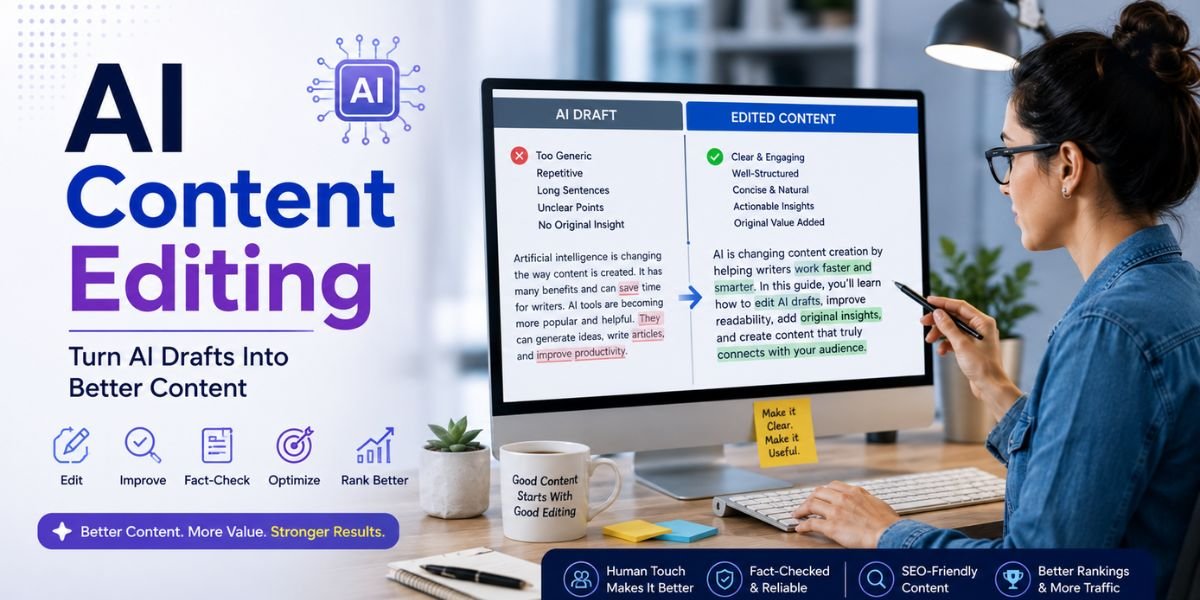
AI has changed the way bloggers create content. A blog post that once took several hours to research, outline, write, and edit can now be drafted much faster with the help of AI writing tools. However, using AI for blog writing does not mean you should publish everything an AI tool generates. If you want to use AI for blog writing without SEO problems, you need to combine artificial intelligence with keyword research, search intent, human editing, fact-checking, originality, and a clear content strategy.
Google does not automatically consider AI-generated content a problem. Its guidance says generative AI can be useful for researching topics and adding structure to original content. The concern is using automation to produce large amounts of pages without providing meaningful value to users.
This means bloggers can use AI as part of their workflow while still following SEO best practices. The key is to treat AI as a writing assistant rather than a shortcut for publishing hundreds of generic articles.
What Does Using AI for Blog Writing Mean?
Using AI for blog writing means using artificial intelligence to assist with one or more stages of the content creation process. AI can help with brainstorming, research assistance, outlines, drafts, headline ideas, content expansion, editing, summaries, and content optimisation.
The important distinction is between AI-assisted content creation and fully automated content production. In an AI-assisted workflow, a person remains responsible for the topic, purpose, research, accuracy, originality, editing, and final publishing decision.
How AI Can Help Bloggers
AI writing tools can support bloggers in several practical ways.
You can use AI to:
- Generate blog topic ideas
- Create content outlines
- Find related questions
- Suggest subtopics
- Create headline variations
- Draft introductions
- Expand short notes
- Rewrite unclear sentences
- Improve grammar
- Create FAQs
- Suggest internal link opportunities
- Repurpose existing content
- Create social media summaries
- Develop content briefs
This can save time, especially when a writer already understands the topic and knows what the article needs to accomplish.
What AI Should Not Do Alone
AI should not be responsible for every important decision.
You should not blindly allow an AI tool to decide:
- What your audience needs
- Whether a fact is accurate
- Whether a product recommendation is trustworthy
- Whether a statistic is current
- Whether an article satisfies search intent
- Whether an expert claim is reliable
- Whether your content is genuinely original
These decisions require human judgement.
Google’s people-first guidance encourages creators to ask whether their content provides original information, research, analysis, substantial value, and a satisfying experience for readers.
Can You Use AI for Blog Writing Without SEO Problems?
Yes, you can use AI for blog writing without SEO problems when the content is created primarily to help people and provides genuine value. Google says AI or automation is not automatically against its Search guidelines. The issue occurs when automation is used primarily to manipulate search rankings or produce large quantities of unoriginal, low-value pages.
This distinction is extremely important for bloggers.
Using AI to create an outline for a useful article is very different from generating hundreds of pages, changing a few words, and publishing them without review.
AI Does Not Give Content a Ranking Advantage
AI-generated content does not receive a special SEO boost simply because AI was used.
Google explains that its systems focus on the quality of content rather than whether it was produced by AI or humans. Useful, original, helpful content can perform well, while low-quality content may not perform well regardless of how it was produced.
Therefore, do not use AI because you believe Google rewards AI content.
Use AI because it can make your content workflow more efficient.
Start With Keyword Research
The first step to use AI for blog writing without SEO problems is to start with proper keyword research.
Do not begin by asking an AI tool to “write an SEO blog post” without knowing the keyword, audience, and search intent.
Identify the main phrase you want the page to target.
For example, if your topic is AI website building, your primary keyword might be:
AI website builder
Related keywords could include:
- AI website creator
- build a website with AI
- AI web design
- AI website generator
- create a website using AI
These related phrases help you understand the broader topic.
Do Not Stuff Keywords Into the Article
Adding a keyword repeatedly does not make an article more SEO-friendly.
Google recommends using words that people would use to find your content and placing relevant terms in prominent locations such as the title and main heading, along with descriptive locations such as link text and alt text.
Use keywords naturally.
The article should sound like it was written for a person, not a search engine.
Understand Search Intent Before Writing

Search intent is one of the most important parts of SEO.
Before using AI to generate an outline, determine what the searcher actually wants.
For example, someone searching for:
“best AI website builders”
probably wants a comparison.
Someone searching for:
“how to build a website with AI”
probably wants a tutorial.
Someone searching for:
“AI website builder pricing”
probably wants pricing information.
If your article does not satisfy the intent behind the keyword, even excellent writing may not produce the results you want.
Give AI the Search Intent
When creating an AI prompt, explain the intended audience and search purpose.
Instead of:
“Write a 2,000-word SEO article about AI website builders.”
Use a more specific instruction:
“Create an outline for beginners who want to build a business website using an AI website builder. Explain the process, important features, pricing considerations, SEO requirements, advantages, limitations, and common mistakes.”
The second approach gives AI a much clearer direction.
Create the Outline Before the Draft
One of the best ways to use AI for blog writing without SEO problems is to use AI for structure before asking it to create long-form content.
Start with your main topic and divide it into useful sections.
For example:
Introduction
Explain the topic and what the reader will learn.
What Is an AI Website Builder?
Provide a clear definition.
How Does an AI Website Builder Work?
Explain the process.
Key Features to Look For
Discuss important features.
Benefits and Limitations
Provide balanced information.
How to Choose the Right Tool
Give practical advice.
Final Thoughts
Summarise the key points.
This creates a logical structure and reduces the chance of AI producing repetitive sections.
Give AI Better Instructions
The quality of AI output often depends on the instructions you provide.
A vague prompt usually creates generic content.
A detailed prompt provides better direction.
Tell the AI:
- Who the audience is
- What the main keyword is
- What the search intent is
- What tone to use
- What sections to cover
- What examples to include
- What claims require verification
- What information should be avoided
- What internal links may be relevant
- What the article should help the reader accomplish
Use AI as an Assistant
Think of AI as a junior content assistant.
You provide the strategy.
AI helps with execution.
You review the result.
You add expertise.
You make the final decision.
This workflow gives you much more control than asking AI to create an article and publishing the output immediately.
Add Original Information
Originality is one of the biggest differences between useful AI-assisted content and generic AI content.
An AI tool can explain a common topic using information that is already widely available.
Your job is to add something readers cannot get from every other website.
This could include:
- Original research
- Personal experience
- Product testing
- Screenshots
- Case studies
- Expert interviews
- Unique examples
- Industry observations
- Data analysis
- Practical comparisons
- Step-by-step instructions
Google’s helpful content guidance asks whether content provides original information, research, analysis, insightful information, or substantial value compared with other pages.
Share Real Experience
Suppose you publish an article about AI website builders.
Instead of only describing features, explain what happened when you actually used a tool.
You could discuss:
- How long setup took
- What the AI generated
- How easy the website was to edit
- Whether the mobile version worked well
- What SEO controls were available
- Which features were useful
- What limitations you found
These details make an article much more useful.
Fact-Check AI-Generated Information
Fact-checking is essential when you use AI for blog writing.
AI tools can produce information that sounds accurate but is incorrect, outdated, or incomplete.
Always verify important claims before publishing.
Check:
- Statistics
- Dates
- Pricing
- Product specifications
- Company information
- Research findings
- Government information
- Technical instructions
- Medical claims
- Financial claims
- Google Search policies
Google specifically recommends focusing on accuracy, quality, and relevance when automatically generating content.
Use Reliable Sources
When checking facts, prioritise authoritative sources.
For example:
- Official company documentation
- Government websites
- Academic research
- Recognised industry organisations
- Original research reports
- Official Google documentation
Do not rely entirely on AI to determine whether a claim is true.
Human Edit Every AI Draft

Human editing is one of the most important steps in an AI content workflow.
Never assume that an AI-generated article is ready to publish simply because the grammar is correct.
Read the complete article.
Look for:
- Repeated ideas
- Generic phrases
- Incorrect information
- Weak explanations
- Unnecessary sections
- Awkward sentences
- Unsupported claims
- Missing examples
- Keyword stuffing
- Poor transitions
Then rewrite the content.
Make the Writing Sound Natural
AI-generated text can sometimes sound overly formal or repetitive.
For example:
“By implementing these strategies, businesses can effectively leverage the power of AI to enhance their digital presence.”
A more natural version might be:
“These strategies can help businesses use AI to improve their websites.”
The second sentence is shorter and clearer.
Good SEO content does not need complicated language.
Google’s SEO Starter Guide recommends content that is easy to read, well organised, unique, useful, and up to date.
Avoid Publishing Mass-Produced AI Articles
One of the biggest SEO risks is publishing a large number of low-value AI articles simply because AI makes content production fast.
Google’s current spam policy defines scaled content abuse as producing many pages primarily to manipulate search rankings rather than help users. It specifically includes generating many pages with AI without adding value.
This means publishing 500 generic articles is not a good SEO strategy just because an AI tool can create them quickly.
Focus on Quality Over Quantity
Instead of publishing ten weak articles, create one strong article.
A useful article should answer the reader’s main question and cover the information they need.
Ask yourself:
“Would I bookmark this article?”
“Would I share it with someone?”
“Does it provide information that is genuinely useful?”
“Does it add something beyond existing search results?”
If the answer is no, improve the article before publishing it.
Use Related Keywords Naturally
NLP-friendly SEO does not mean repeating the exact keyword throughout an article.
Modern search systems can understand relationships between words and topics.
For example, if your primary keyword is AI blog writing, naturally related phrases might include:
- AI writing tools
- blog content
- content creation
- SEO content
- keyword research
- search intent
- blog post ideas
- content optimisation
- human editing
- Google Search
- organic traffic
- people-first content
Use these terms where they genuinely fit.
Google’s documentation notes that its language-matching systems can understand how pages relate to different queries without requiring creators to use every possible variation of a search term.
Optimise Your Title and Headings
Your page title should clearly communicate what the article is about.
For example:
How to Use AI for Blog Writing Without SEO Problems
This title immediately tells the reader the subject and benefit.
Use H2 headings for major sections and H3 headings for supporting topics.
A strong structure makes long-form content easier to scan.
Write Descriptive Headings
Avoid vague headings such as:
“Important Information”
Instead, use:
“How AI Can Help Bloggers Save Time”
The second heading tells readers exactly what they will learn.
Clear headings also help search engines understand the structure of your content.
Optimise the Introduction
Your introduction should quickly answer the reader’s concern.
If someone searches for “how to use AI for blog writing without SEO problems”, they probably want to know whether using AI can hurt their rankings and how to use it safely.
Answer that early.
Do not spend the first 300 words discussing the history of artificial intelligence.
Give readers the answer first, then explain the process.
Optimise Meta Titles and Descriptions
AI can also help create metadata, but you should review it manually.
Your meta title should be descriptive and relevant.
Your meta description should explain what the page offers.
Google says metadata should focus on accuracy, quality, and relevance when using generative AI.
Avoid generating dozens of near-identical meta descriptions automatically.
Each page should have metadata that accurately represents its content.
Use Internal Linking
Internal links are useful for both readers and website structure.
When writing an AI-assisted article, identify other relevant pages on your website.
For example, an article about AI blog writing could link to:
- AI writing tools
- AI SEO tools
- AI website builders
- AI content humanisation
- AI-generated website design
- SEO content writing
Use Relevant Anchor Text
Instead of using:
“Click here”
use descriptive anchor text such as:
“learn how to humanise AI content”
The anchor text tells readers what they will find on the linked page.
Do not add internal links where they do not make sense.
Relevance matters more than link quantity.
Optimise Images and Alt Text
AI can also help create image ideas, captions, and alt text.
However, alt text should describe the image accurately.
If an image shows a person using an AI writing tool on a laptop, suitable alt text might be:
“Writer using an AI writing tool to create blog content”
Do not stuff keywords into image alt text.
Google’s Search Essentials recommends using relevant terms in descriptive locations such as alt text when appropriate.
Make Content Useful for AI Search

Google’s AI search experiences are another reason to focus on useful content.
Google says its guidance for AI Overviews and AI Mode continues to emphasise unique, satisfying content that provides value to visitors. It also says the core SEO principles remain relevant for these experiences.
This means you should not create a separate article filled with artificial “AI SEO tricks”.
Instead, make your existing content stronger.
Answer Questions Clearly
Use direct answers where appropriate.
For example:
Can AI-written blog posts rank on Google?
Yes. AI-assisted content can rank when it is useful, original, accurate, and created primarily to help users. AI itself does not provide a special ranking advantage.
Then explain the details.
This structure is useful for readers who want a quick answer and for people who want a deeper explanation.
Improve the Page Experience
SEO does not stop with writing.
Your article should also provide a good page experience.
Google recommends ensuring that pages work properly, can be crawled and indexed, display well across devices, and allow visitors to find the information they need.
Check:
- Mobile responsiveness
- Page speed
- Font readability
- Navigation
- Image sizes
- Pop-ups
- Advertising
- Internal links
- Page layout
- HTTPS
- Crawlability
- Indexability
A great article hidden inside a difficult website can still create a poor experience.
Consider AI Disclosure Where Appropriate
AI disclosure is not necessarily required for every piece of content simply because AI was involved.
Google’s guidance says disclosures can be useful when readers would reasonably wonder how the content was created.
For example, if an article includes AI-generated elements or automation that would be relevant to readers, explaining how AI was used can provide useful context.
Transparency should be based on the nature of the content and what readers would reasonably expect to know.
Avoid These AI SEO Mistakes
Several mistakes can create problems when bloggers use AI.
Publishing the First Draft
AI output should normally be reviewed before publication.
Keyword Stuffing
Do not repeat your primary keyword unnaturally.
Creating Hundreds of Similar Pages
Large-scale low-value content can fall under Google’s scaled-content-abuse policy.
Making Fake Experience Claims
Do not claim that you personally tested a product or visited a location if you did not.
Using Unverified Statistics
Check statistics before publishing them.
Rewriting Competitors Without Adding Value
Changing words while keeping the same information does not create strong original content.
Writing Only for Search Engines
Google’s guidance says the purpose of content should be to help people, not primarily to attract search traffic.
A Safe AI Blog Writing Workflow
A simple workflow can help you use AI for blog writing without SEO problems.
Step 1: Choose a Useful Topic
Start with a real audience need.
Step 2: Research the Keyword
Identify the primary keyword and related search terms.
Step 3: Understand Search Intent
Determine what the reader wants.
Step 4: Research the Topic
Use reliable sources and identify information gaps.
Step 5: Create an Outline
Use AI to help organise the article.
Step 6: Write the Draft
Use AI where it saves time.
Step 7: Add Original Value
Include your own examples, experience, research, testing, and analysis.
Step 8: Fact-Check
Verify important claims.
Step 9: Human Edit
Improve clarity, tone, structure, and accuracy.
Step 10: Optimise for SEO
Review the title, headings, keywords, internal links, images, URL, and metadata.
Step 11: Review Search Intent Again
Make sure the final article still answers the original question.
Step 12: Publish and Monitor
Use Search Console and website analytics to understand how the content performs.
If a page does not perform as expected, review whether it provides enough value and whether it satisfies the searcher’s intent.
How to Use AI Without Losing Your Brand Voice
Your brand voice should remain consistent even when AI helps create the content.
Before using AI, define:
- Tone
- Audience
- Writing style
- Vocabulary
- Sentence length
- Brand personality
- Topics you cover
- Topics you avoid
- Preferred examples
- Editorial standards
Then use those guidelines when creating AI-assisted drafts.
Create Your Own Content Guidelines
For example, your website could follow these rules:
“Use clear British English. Keep paragraphs short. Explain technical concepts in simple language. Avoid unnecessary jargon. Use practical examples. Do not make unsupported claims. Use keywords naturally. Prioritise readers over search engines.”
These instructions give AI a consistent framework.
However, the final content should still receive human review.
How Often Should You Publish AI-Assisted Blog Posts?
There is no magic publishing frequency that guarantees SEO success.
Publishing more content does not automatically mean more organic traffic.
A better approach is to create a sustainable publishing schedule that allows enough time for research, editing, internal linking, updating, and quality control.
Google’s helpful content guidance warns against producing lots of content across many topics simply in the hope that some of it will perform well in search.
Instead, build topical depth around subjects that are genuinely relevant to your audience.
Should You Use AI for Every Blog Post?
No.
Some topics may benefit greatly from AI assistance, while others require much stronger human involvement.
AI is useful for:
- Brainstorming
- Outlining
- Routine explanations
- Content repurposing
- Editing
- Summaries
- Headline ideas
Human expertise is especially important for:
- First-hand reviews
- Personal stories
- Expert commentary
- Sensitive subjects
- Original research
- Interviews
- Technical analysis
- Product testing
- Opinion pieces
The more experience and judgement a topic requires, the more important human involvement becomes.
Final Checklist for AI Blog Writing
Before publishing an AI-assisted blog post, ask yourself:
- Is the topic useful to my audience?
- Does the article satisfy search intent?
- Is the primary keyword relevant?
- Are related terms used naturally?
- Is the title descriptive?
- Are H2 and H3 headings useful?
- Does the introduction answer the main question?
- Did I fact-check important claims?
- Did I add original information?
- Did I include useful examples?
- Did I remove repetitive AI-generated sections?
- Does the article sound natural?
- Did I avoid keyword stuffing?
- Are internal links relevant?
- Is the metadata accurate?
- Are images useful and properly described?
- Is the page mobile-friendly?
- Can Google crawl and index the page?
- Would I recommend this article to someone?
- Does the article provide more value than a basic summary?
If you can confidently answer yes to these questions, your AI-assisted blog post has a much stronger foundation.
Must Read:
- How to Humanize AI Content Without Losing SEO?
- AI Writing vs Human Writing: Which Is Better in 2026?
- How to Write AI Content That Ranks on Google in 2026?
Final Thoughts:
Learning How to Use AI for Blog Writing Without SEO Problems is less about avoiding AI and more about using it correctly.
AI can make blogging faster and more efficient. It can help you generate ideas, organise information, create outlines, improve sentences, and repurpose content. But it should not become a replacement for research, originality, expertise, fact-checking, or editorial judgement.
Google’s current guidance is clear: AI-generated content is not automatically against Search guidelines. The problem is using automation primarily to manipulate rankings or producing large amounts of unoriginal content without meaningful value.
The safest approach is to keep humans in control of the content strategy.
Start with search intent.
Research the topic.
Use AI to assist with planning and drafting.
Add original information.
Fact-check important claims.
Edit the content carefully.
Use keywords naturally.
Build useful internal links.
Optimise the page experience.
Then publish content that genuinely helps the reader.
Google’s current Search guidance also emphasises unique, valuable content for both traditional Search and newer AI experiences such as AI Overviews and AI Mode.
The goal is not to create the largest amount of AI content possible. The goal is to create the most useful content possible with the help of AI.
When you follow that principle, AI becomes a productivity tool rather than an SEO shortcut, allowing you to publish better blog content while protecting the quality and long-term value of your website.