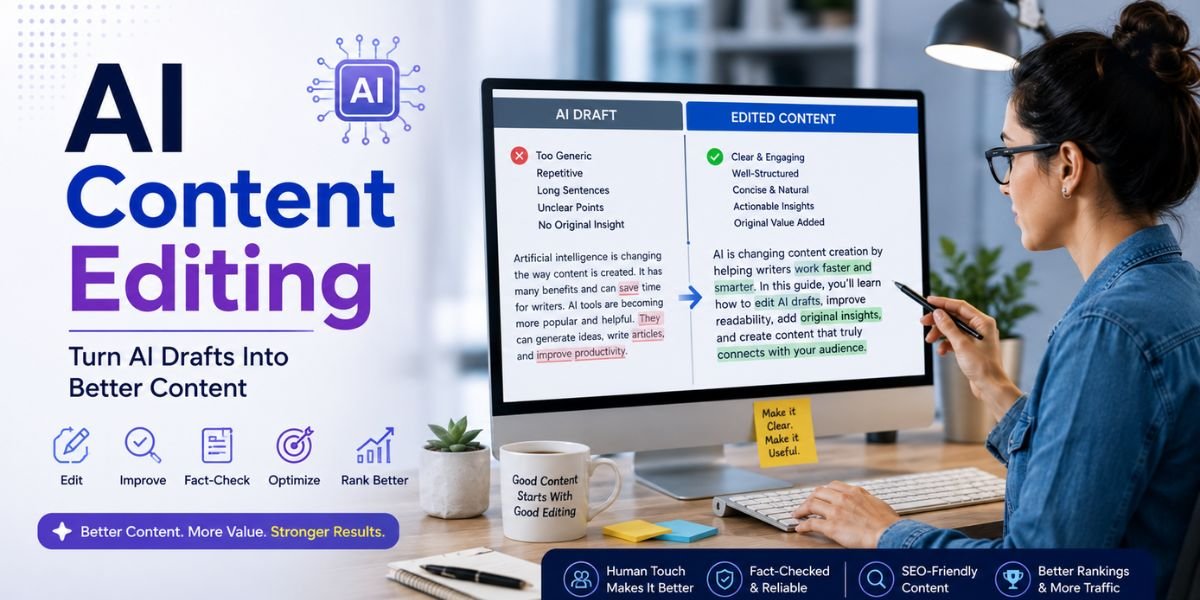
AI writing has changed the way bloggers, businesses, marketers, students, and content creators produce online content. AI writing tools can create drafts in seconds, generate ideas, organise information, and help writers work faster. At the same time, human writing still offers qualities that AI cannot reliably reproduce, including personal experience, original judgement, emotion, expertise, and a genuine understanding of an audience. This makes AI Writing vs Human Writing an important discussion for anyone creating content in 2026.
The answer is not as simple as saying that AI writing is better or human writing is better. In many situations, the strongest content comes from combining both approaches. AI can handle repetitive and time-consuming tasks, while human writers can provide direction, originality, fact-checking, editing, and personal insight. Google also states that the focus should be on helpful, reliable, people-first content rather than whether content was produced by AI or by a person.
AI Writing vs Human Writing: What Is the Difference?
The main difference between AI writing and human writing is how the content is created and where its ideas come from. AI writing uses artificial intelligence models to predict and generate text based on patterns learned from large amounts of data, while human writing comes from a person’s knowledge, experience, research, opinions, creativity, and judgement.
AI writing can be extremely fast. A writer can provide a topic, audience, tone, and structure and receive a draft within seconds or minutes. Human writing generally takes longer because the writer needs to research the topic, think about the message, organise ideas, write the content, and revise it.
However, speed is only one part of content quality.
What Is AI Writing?
AI writing refers to text created with the assistance of artificial intelligence software. Modern AI writing tools can help create blog posts, product descriptions, social media posts, emails, outlines, advertisements, website copy, summaries, and many other forms of content.
AI can also help writers improve existing content. For example, a writer can use AI to shorten a paragraph, suggest alternative headlines, organise a long article, explain a technical concept, or identify areas that need more detail.
Google’s current guidance says generative AI can be useful for researching topics and adding structure to original content. However, generating many pages without adding value for users can violate Google’s policies concerning scaled content abuse.
What Is Human Writing?
Human writing is content created primarily through a person’s own knowledge, experience, research, creativity, and judgement.
A human writer can understand context in ways that are difficult to automate completely. A writer who has personally tested a product can describe what happened during testing. A travel writer who visited a destination can explain details that may not appear in standard online sources. A business expert can share lessons learned from years of experience.
These first-hand details can make content more useful and memorable.
Google’s people-first content guidance specifically encourages content that demonstrates first-hand expertise and provides original information, research, analysis, or substantial additional value.
Is AI Writing Better Than Human Writing?
AI writing is better for some tasks, while human writing is better for others. The most effective approach depends on the purpose, subject, audience, and quality requirements of the content.
AI is particularly useful when speed, brainstorming, organisation, and repetitive tasks are important. Human writing becomes more valuable when the content requires experience, emotional understanding, original opinions, expert judgement, or a distinctive brand voice.
Where AI Writing Has an Advantage
The biggest advantage of AI writing is speed. An AI tool can generate an initial outline or draft much faster than a person can write one from scratch.
AI is also useful for brainstorming. If a writer has difficulty finding article ideas, AI can suggest possible angles, questions, titles, and subtopics.
Another advantage is organisation. AI can turn a large amount of information into a logical outline, helping writers decide which points should appear first and which sections need more explanation.
AI can also assist with editing. It can identify grammar problems, simplify sentences, suggest alternative wording, and help maintain a consistent tone.
For businesses producing large amounts of routine content, these benefits can save significant time.
Where Human Writing Has an Advantage
Human writing has a major advantage when originality and experience matter.
A human writer can say, “I tested this product for 30 days and here is what happened.” An AI system cannot genuinely claim that experience unless the information comes from a real person or reliable source.
Humans can also make editorial decisions based on context. A writer understands when a joke is inappropriate, when a sensitive topic needs a careful explanation, or when a particular audience requires a different tone.
Human writers can also develop a distinctive voice over time. This is especially important for brands that want their content to be recognisable.
AI Writing vs Human Writing for SEO
SEO is one of the biggest reasons people compare AI Writing vs Human Writing. Many website owners want to know whether Google prefers content written by people or content produced with AI.
Google’s guidance does not say that AI-generated content is automatically excluded from Search. Google explains that its systems aim to reward original, high-quality content regardless of how it was produced. At the same time, using automation primarily to manipulate search rankings violates Google’s spam policies.
This means the better question is not “Was AI used?”
The better question is “Does this content genuinely help the reader?”
Can AI Content Rank on Google?
Yes, AI-assisted content can rank on Google, but AI does not provide a special ranking advantage.
Google explains that content created with AI is treated as content. If it is useful, helpful, original, and demonstrates appropriate E-E-A-T qualities, it may perform well. If it provides little value, simply using AI will not make it successful.
For this reason, publishing an AI-generated article without research, editing, fact-checking, or original information is not a strong SEO strategy.
Why Human Editing Matters for SEO
Human editing can improve AI content in several important ways.
A writer can add original examples, remove repetitive sections, correct inaccurate information, improve search intent, add first-hand experience, and make the article more useful.
Google’s helpful content guidance asks creators to consider whether their content provides original information, substantial value, insightful analysis, and a satisfying experience for readers.
Human involvement can therefore make AI-assisted content more useful and distinctive.
AI Writing vs Human Writing for Creativity

Creativity is another area where the comparison becomes interesting.
AI can generate many ideas quickly. It can combine concepts, suggest different angles, create fictional scenarios, and experiment with different tones.
However, human creativity comes from lived experiences, emotions, culture, memories, observations, and personal perspectives.
AI Is Excellent for Idea Generation
Suppose you want to write an article about AI website design.
AI can suggest dozens of possible topics:
- AI website design trends
- AI website builders
- AI-generated landing pages
- AI website UX
- AI web design mistakes
- AI tools for designers
- Human designers vs AI designers
This can help a writer overcome writer’s block.
AI is therefore valuable as a creative assistant.
Humans Add Original Perspective
The problem begins when every writer uses the same AI-generated ideas without adding anything personal.
If ten websites publish almost identical articles, readers have little reason to prefer one over another.
Human writers can make an article different by adding personal observations, original examples, unique research, opinions, case studies, interviews, or practical testing.
That additional perspective is often what transforms ordinary content into valuable content.
AI Writing vs Human Writing for Accuracy
Accuracy is essential for high-quality content, especially when an article discusses technology, finance, health, law, or other topics where incorrect information can cause serious problems.
AI tools can sometimes generate incorrect information with a confident tone. They may also produce outdated details or misunderstand a question.
Human writers can make mistakes too, but professional research and editorial review provide an important layer of quality control.
Why AI Information Should Be Fact-Checked
AI-generated information should not automatically be treated as verified information.
Before publishing important claims, check reliable sources. Look for original documentation, official websites, reputable publications, research papers, or recognised industry sources.
Google’s guidance specifically recommends focusing on accuracy, quality, and relevance when using generative AI for web content.
A strong workflow is simple:
AI generates ideas → writer researches → writer verifies → writer edits → final content is published.
This approach is much safer than publishing an AI draft without review.
AI Writing vs Human Writing for Content Marketing
Content marketing requires more than grammatically correct sentences. Good marketing content needs to understand customer needs, communicate benefits, establish trust, and encourage action.
AI can help with many parts of the process.
How AI Helps Content Marketers
AI can help marketers:
- Generate content ideas
- Create article outlines
- Draft social media posts
- Write email variations
- Develop headline ideas
- Create product description drafts
- Repurpose long-form content
- Summarise customer feedback
- Suggest calls to action
- Adapt content for different audiences
These capabilities can make a marketing team much more productive.
Why Human Strategy Still Matters
Marketing decisions require context.
A human marketer understands the company’s positioning, customers, competitors, products, brand voice, and business objectives.
AI can suggest ten headlines, but a human needs to decide which headline best represents the brand.
AI can create an advertisement, but a human should determine whether the message is appropriate for the target audience.
This is why the future of content marketing is likely to involve collaboration rather than complete replacement.
AI Writing vs Human Writing for Blog Posts
Blogging is another area where AI can provide significant support.
AI can help bloggers create outlines, research questions, draft sections, improve readability, and develop content calendars.
However, successful blogging requires more than publishing large numbers of articles.
What Makes a Strong Blog Post?
A strong blog post should:
- Match search intent
- Answer the reader’s question
- Provide accurate information
- Use clear language
- Offer original value
- Include useful examples
- Be easy to navigate
- Use relevant internal links
- Provide a good page experience
- Be updated when information changes
Google’s Search Essentials recommends creating helpful, reliable, people-first content and using words that people would use to search for the information.
Google also says there is no preferred word count that guarantees rankings. The objective should be to provide enough useful information to satisfy the reader rather than adding words simply to reach a target.
The Best Approach: Combine AI and Human Writing

Instead of treating AI Writing vs Human Writing as an either-or decision, website owners should consider a hybrid approach.
AI can take care of repetitive work while humans focus on strategy and quality.
Step 1: Start With Human Strategy
Before opening an AI writing tool, decide:
- Who is the audience?
- What problem are you solving?
- What keyword are you targeting?
- What is the search intent?
- What makes your article different?
- What information needs expert verification?
This gives the AI a clear purpose.
Step 2: Use AI for Research and Structure
Ask AI to help organise your ideas, identify questions, create an outline, or suggest content angles.
Do not rely on AI as your only research source.
Step 3: Create the First Draft
AI can produce a useful starting point, especially for routine sections.
The draft does not need to be perfect.
Its purpose is to give you material to work with.
Step 4: Add Human Experience
This is where the article can become substantially better.
Add:
- Personal experience
- Original examples
- Case studies
- Expert opinions
- Testing results
- Unique observations
- Industry knowledge
- Original research
These elements can make the content more valuable than generic AI output.
Step 5: Edit and Fact-Check
Read the entire article carefully.
Remove repetitive language, verify facts, correct errors, improve transitions, and make sure the content actually answers the reader’s question.
Step 6: Optimise for Search
After the content is useful, apply SEO.
Optimise the title, headings, meta description, internal links, image alt text, URL, and other relevant elements naturally.
Google’s SEO guidance explains that SEO can be useful when applied to people-first content rather than content created primarily for search engines.
Will AI Replace Human Writers in 2026?
AI is likely to change the role of writers, but it does not mean that all human writers will disappear.
The types of writing jobs most affected are likely to be repetitive tasks where the required output follows a predictable pattern.
However, areas requiring original thinking, expertise, interviews, storytelling, brand strategy, research, editorial judgement, and personal experience continue to benefit greatly from human involvement.
Writers Who Use AI May Have an Advantage
A writer who knows how to use AI effectively can often complete routine work faster.
For example, instead of spending an hour creating an outline, the writer can use AI to generate several possible structures and then select and improve the best one.
The writer can spend the saved time on research, interviews, editing, strategy, and original insights.
This changes the role of the writer from simply producing sentences to managing the entire content creation process.
How AI Writing Will Change Content Creation
The future of content creation is likely to involve more collaboration between people and AI tools.
AI will continue becoming better at generating drafts, analysing information, organising ideas, and adapting content for different formats.
Human writers will continue to provide judgement, creativity, experience, strategy, and accountability.
Google’s guidance for its AI search experiences also continues to emphasise unique, satisfying content that provides real value to visitors. The same principles apply across traditional Search and newer AI experiences such as AI Overviews and AI Mode.
This makes originality more important, not less important.
Common Mistakes to Avoid With AI Writing
AI writing can save time, but several mistakes can reduce content quality.
Publishing the First AI Draft
An AI draft is a starting point, not necessarily the final article.
Always review and edit it.
Producing Large Amounts of Generic Content
Publishing hundreds of low-value pages simply because AI makes production easy can create serious SEO risks. Google defines scaled content abuse as creating many pages primarily to manipulate rankings rather than help users, regardless of whether AI or another method was used.
Copying Existing Ideas
AI should not be used simply to rewrite competing articles.
Find opportunities to add something new.
Ignoring Search Intent
A well-written article can still perform poorly if it does not answer what the searcher actually wants.
Forgetting Human Experience
Generic content often lacks the practical details readers want.
Add real examples, observations, testing, and expert insight where appropriate.
Focusing Only on Word Count
Longer does not automatically mean better.
Google explicitly says creators should not write to a particular word count simply because they believe Google has a preferred number.
AI Writing vs Human Writing: Final Comparison
When comparing AI Writing vs Human Writing, neither approach wins every category.
AI wins when speed, scale, brainstorming, organisation, and repetitive work are the priority.
Human writing wins when experience, originality, emotion, judgement, storytelling, expertise, and brand voice are important.
For modern websites, the strongest strategy is usually a combination.
| Factor | AI Writing | Human Writing |
|---|---|---|
| Speed | Excellent | Moderate |
| Idea generation | Excellent | Excellent |
| Personal experience | Limited | Excellent |
| Original perspective | Limited without human input | Excellent |
| Repetitive tasks | Excellent | Moderate |
| Emotional understanding | Limited | Excellent |
| Fact-checking | Requires verification | Requires verification |
| Brand voice | Needs guidance | Strong |
| SEO support | Excellent | Excellent |
| Editing | Good | Excellent |
| Storytelling | Good | Excellent |
| Scalability | Excellent | Limited |
| Expert judgement | Limited | Excellent |
The most effective workflow combines the strengths of both.
Must Read:
- How to Write AI Content That Ranks on Google in 2026?
- Can AI Replace Web Developers in 2026?
- AI Website Development: Complete Guide for Beginners
Final Verdict:
So, AI Writing vs Human Writing: Which Is Better in 2026?
The answer is that human-led AI writing is often the strongest approach.
AI is excellent at helping writers work faster. It can generate ideas, organise information, create drafts, improve wording, and handle repetitive content tasks. But AI should not replace human judgement, research, editing, originality, and expertise.
Human writers bring the qualities that make content genuinely valuable. They can provide first-hand experience, original analysis, emotional context, unique opinions, and a distinctive voice.
For SEO, the distinction is especially important. Google does not say that AI content is automatically bad or that human-written content automatically ranks. Instead, Google’s systems aim to reward helpful, reliable, original, people-first content.
Therefore, the smartest strategy in 2026 is not to ask whether AI or humans should write your content.
Use AI where it saves time.
Use humans where judgement matters.
Research before publishing.
Fact-check important information.
Add original value.
Edit every important article.
Write for people first and search engines second.
When these elements work together, AI becomes a powerful writing assistant rather than a replacement for quality content creation. The future belongs less to “AI writers” or “human writers” alone and more to skilled content creators who know how to combine technology with human expertise.