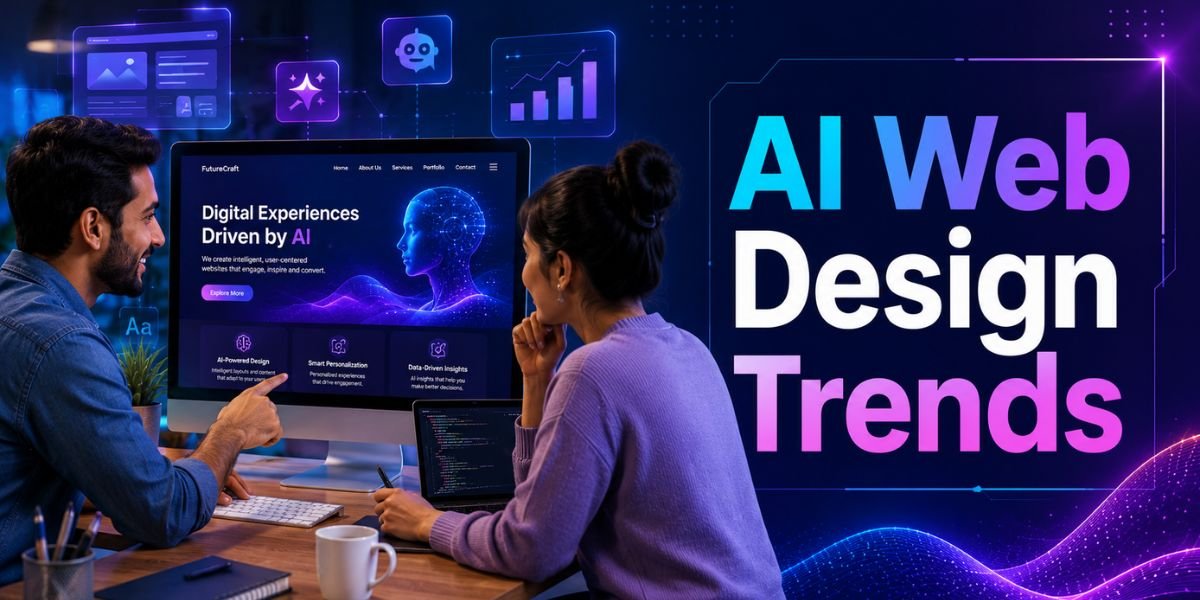
AI Web Design Trends are changing how websites are planned, designed, built, personalised, and optimised in 2026. Artificial intelligence is no longer used only to generate website copy or create a basic layout. It is increasingly becoming part of the complete web design workflow, from creating wireframes and visual concepts to personalising user experiences and helping websites work with emerging AI agents.
The biggest shift behind current AI Web Design Trends is that websites are becoming more adaptive and useful. Instead of giving every visitor exactly the same experience, businesses can use AI to help people find information, compare products, complete tasks, and move through a website more efficiently. At the same time, visual design is becoming more expressive, with stronger typography, purposeful animation, interactive 3D, and more distinctive brand styles.
However, not every trend is worth adding to a website. A professional website still needs to load quickly, work on mobile devices, remain accessible, provide useful information, and make important actions easy to complete. Google continues to emphasise strong technical SEO, useful content, good page experience, and crawlable website structures for both traditional Search and its generative AI experiences.
In this guide, we explore 10 AI Web Design Trends that are shaping modern websites in 2026 and explain how businesses can use them without sacrificing usability, SEO, accessibility, or performance.
What Are AI Web Design Trends?
AI Web Design Trends describe the emerging design practices, technologies, and user experiences influenced by artificial intelligence and modern web development. These trends cover both the way websites are created and the way visitors interact with them.
How AI Is Changing Website Design
AI can now assist with tasks such as generating layouts, suggesting content structures, creating images, producing interface ideas, analysing design patterns, and helping designers test different concepts.
This means designers can move more quickly from an idea to a working prototype. Instead of spending hours creating every first draft manually, they can use AI to generate options and then spend their time reviewing, refining, and improving the design.
The role of AI is also moving from behind-the-scenes assistance towards the actual website experience. Google describes AI agents as systems that can browse websites, inspect their structure, interpret accessibility information, and perform tasks on behalf of users.
Why These Trends Matter in 2026
The modern website has to serve several audiences at the same time. It needs to work for human visitors, search engines, mobile users, assistive technologies, and increasingly AI-powered systems.
That is why the most useful AI Web Design Trends are not simply about making a website look futuristic. They focus on making websites easier to understand, faster to use, more personalised, more accessible, and more capable of supporting real tasks.
1. AI-Powered Website Creation
AI-powered website creation is one of the most important AI Web Design Trends in 2026. AI website builders can now create initial website structures, page sections, copy, colour combinations, images, and layouts from natural-language instructions.
From Blank Canvas to AI-Generated Layout
Instead of beginning with an empty design screen, a business owner can describe the website they want.
For example, a user might ask an AI website builder to create a professional website for a software company with a homepage, product section, pricing, customer reviews, FAQ, blog, and contact page.
The AI can generate a starting structure that the user can then edit.
This approach can significantly reduce the time needed to create an initial website. It is particularly useful for small businesses, freelancers, bloggers, startups, and people who do not have advanced design or coding skills.
Human Editing Still Matters
One of the most important lessons from AI Web Design Trends is that AI-generated does not automatically mean professional.
The first AI-generated design may contain generic copy, unnecessary sections, poor spacing, unsuitable colours, or images that do not represent the brand.
Use AI to create the first version, then improve it with human judgement. Your final website should reflect your audience, business goals, brand identity, and real customer needs.
2. AI-Powered Personalisation
Personalisation is another major development among AI Web Design Trends. Instead of showing exactly the same content to every visitor, websites can increasingly adapt content, recommendations, navigation, or messaging based on context and user behaviour.
Websites That Adapt to Visitors
AI can help identify patterns such as the type of content a visitor is viewing, the products they are comparing, or the stage they may be at in a buying journey.
For example, an ecommerce website could recommend related products based on browsing behaviour. A software website could highlight different features depending on whether the visitor appears to be an individual user, a small business, or an enterprise customer.
The goal is not to make the website feel mysterious. The goal is to reduce unnecessary steps and make relevant information easier to find.
Personalisation Must Respect Privacy
Good AI Web Design Trends should not ignore privacy. Personalisation should be transparent and should use data responsibly.
Businesses should explain how personal data is used and provide appropriate controls where necessary. Personalisation should improve the experience rather than make visitors feel watched.
A useful principle is simple: personalise the website when it provides clear value to the visitor.
3. Agent-Friendly and Action-Oriented Websites
One of the newer AI Web Design Trends is the emergence of websites designed to work with AI agents. AI agents are moving beyond simply reading information and are increasingly being developed to interact with websites and complete tasks.
What Is an Agent-Friendly Website?
An agent-friendly website makes important information and actions easy for automated systems to understand and use.
For example, an AI agent may need to find a product, compare prices, complete a form, schedule an appointment, or begin a purchase.
Google’s current guidance notes that browser agents can inspect a website’s DOM, screenshots, and accessibility tree when interacting with a site.
Chrome for Developers has also introduced tooling for testing agentic browsing, reflecting the broader shift towards websites that need to support both human visitors and AI agents.
Clear Structure Becomes More Important
For businesses, this trend reinforces the importance of clear labels, predictable navigation, accessible forms, meaningful buttons, structured content, and straightforward user flows.
Emerging technologies such as WebMCP are also being explored to expose structured tools that AI agents can interact with more reliably.
You do not need to rebuild every website around AI agents today. However, designing clear and accessible interactions prepares your website for this changing environment.
4. AI-First Content and Information Architecture
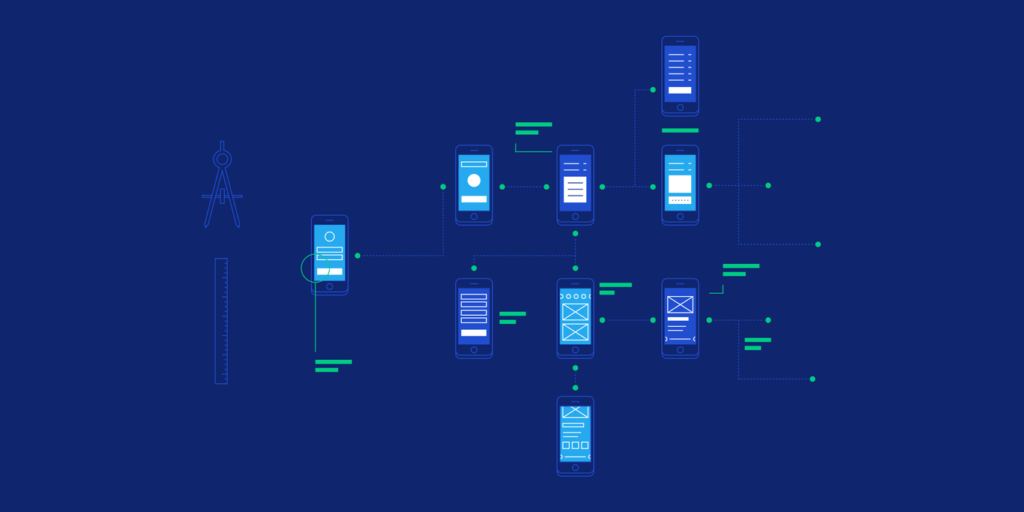
Another important development among AI Web Design Trends is the move towards content structures that help people and machines understand information quickly.
Short Summaries With Deeper Information
People often scan a page before deciding whether to read it fully. Modern websites are therefore using clear summaries, key points, descriptive headings, FAQs, comparison tables, and concise explanations.
A good page can provide the main answer near the beginning and then offer detailed information further down.
This structure benefits human readers because they can quickly understand the topic. It can also make important information easier for search systems and AI-powered interfaces to interpret.
SEO Still Matters
AI search has not made traditional SEO irrelevant. Google states that its AI search experiences continue to rely on core Search systems and that established SEO best practices remain important.
This means your website should still have crawlable pages, useful internal links, descriptive titles, strong content, good page experience, and information that provides genuine value.
Google’s 2026 guidance also emphasises unique, valuable, non-commodity content rather than attempting to manipulate AI search through special hacks.
5. More Human and Distinctive Visual Design
As AI makes it easier to create websites, another of the important AI Web Design Trends is a stronger focus on human creativity and brand differentiation.
Moving Beyond Generic AI Templates
If thousands of businesses use similar AI website builders, many websites can start to look alike.
To stand out, brands are using custom illustrations, original photography, expressive typography, unique colour systems, editorial layouts, hand-crafted details, and distinctive visual patterns.
The goal is not to avoid AI. Instead, businesses are using AI for speed while adding human creativity to make the final result unique.
Stronger Brand Personality
A memorable website should have a recognisable visual identity.
This can include a specific colour palette, typography system, illustration style, photography direction, animation language, and tone of voice.
Among AI Web Design Trends, this is one of the most valuable lessons for businesses: automation should make production faster, not make every brand look identical.
6. Interactive 3D and Spatial Experiences
Interactive 3D is another trend appearing across modern AI Web Design Trends discussions. Better browsers, design tools, and development frameworks are making it easier to introduce depth and interactive elements into websites.
Where 3D Works Well
3D can be particularly useful for:
- Product demonstrations
- Architecture websites
- Automotive websites
- Technology products
- Gaming websites
- Creative portfolios
- Luxury brands
- Interactive storytelling
For example, an ecommerce company could allow visitors to rotate a product or view it from different angles.
Use 3D With a Purpose
The biggest mistake is adding 3D simply because it looks impressive.
Heavy 3D effects can increase page weight and slow down the experience. Current web design discussions increasingly emphasise purposeful and performance-conscious immersive design.
Use 3D when it helps visitors understand something, explore a product, or experience a story. If it does not improve the page, a simpler visual may be better.
7. Purposeful Motion and Micro-Interactions
Motion is becoming more functional in modern AI Web Design Trends. Instead of using animation only for decoration, designers are using subtle movement to communicate actions and provide feedback.
Motion That Helps Users
Examples include:
- Buttons changing state after being clicked
- Form fields showing validation feedback
- Progress indicators during multi-step processes
- Menus opening smoothly
- Images responding subtly to interaction
- Elements appearing as users scroll
These small interactions can make an interface feel more responsive.
Avoid Excessive Animation
Too much movement can distract visitors and make a website uncomfortable to use.
Animation should support the user journey rather than compete with the content. Websites should also respect user preferences such as reduced motion where applicable.
This approach fits the broader direction of AI Web Design Trends, where visual effects are becoming more purposeful rather than simply decorative.
8. Accessibility-First AI Web Design
Accessibility is one of the most important practical AI Web Design Trends for 2026. A modern website should work for as many people as reasonably possible, including people who use keyboards, screen readers, magnification tools, or other assistive technologies.
WCAG 2.2 as a Useful Standard
The World Wide Web Consortium’s WCAG 2.2 provides recommendations for making web content more accessible. It covers areas such as text alternatives, keyboard operation, readable content, predictable interfaces, focus visibility, and target size.
Accessibility should be considered during design rather than added after development.
AI Can Support Accessibility Checks
AI-powered design tools can help identify possible contrast issues, unclear labels, missing information, or inconsistent interface patterns.
However, automated checks should not replace human accessibility testing. A website can pass automated checks and still be difficult for some people to use.
Accessible design often improves usability for everyone. Clear headings, readable text, logical navigation, visible focus states, and well-labelled forms can make a website easier for all visitors.
9. Performance-First Visual Design
Performance remains a major part of AI Web Design Trends because visual quality means little if visitors have to wait for a page to load.
Modern websites often contain large images, animations, videos, interactive components, and third-party scripts. These elements can create performance problems if they are not carefully managed.
Design and Performance Must Work Together
A professional website should balance visual impact with speed.
Use compressed images, responsive image sizes, lazy loading where appropriate, efficient fonts, and lightweight animations. Avoid loading large assets that are not immediately needed.
Google’s Core Web Vitals focus on loading performance, interactivity, and visual stability. The current recommended targets include an LCP of 2.5 seconds or less, INP of 200 milliseconds or less, and CLS of 0.1 or less at the 75th percentile.
Faster Websites Create Better Experiences
Performance is not simply a technical SEO task. It is part of design.
A fast website allows visitors to reach the content and complete actions with less friction. This is especially important for mobile users and visitors on slower connections.
Among the current AI Web Design Trends, performance-first design is one trend that should remain important even when visual styles change.
10. Bold Typography and Expressive Layouts
The final trend in our list of AI Web Design Trends is the growing use of expressive typography and more distinctive layouts.
Larger and More Confident Headlines
Many modern websites use large headlines to establish hierarchy and communicate the main message quickly.
Instead of filling the top of the page with long paragraphs, designers can use a strong headline, short supporting text, and a clear call to action.
Typography can also become part of the brand identity. A distinctive typeface, variable font, or carefully designed heading system can make a website more recognisable.
Breaking Away From Predictable Grids
Websites are also experimenting with asymmetry, layered sections, organic shapes, bold colour combinations, bento-style layouts, and editorial compositions.
However, expressive design still needs structure. Visitors should know where to look, what to read, and what to do next.
The strongest AI Web Design Trends combine creativity with usability. A unique layout is valuable only when visitors can understand and use it easily.
How to Use AI Web Design Trends Without Overdesigning
Following every trend is not a good web design strategy. A website can become confusing if it includes AI personalisation, 3D animation, oversized typography, multiple pop-ups, moving backgrounds, chatbots, and complex interactions all at once.
Choose Trends Based on Your Business
A SaaS company may benefit from AI-assisted search and personalisation. An ecommerce business may benefit from 3D product views. A creative agency may benefit from expressive typography and interactive storytelling.
Choose trends based on your customers and business goals.
Prioritise Function Over Decoration
Before adding a design feature, ask one simple question:
Does this make the website easier, clearer, faster, or more useful for the visitor?
If the answer is no, you may not need it.
This approach allows you to use AI Web Design Trends without turning your website into an overloaded collection of visual effects.
How AI Web Design Trends Affect SEO in 2026
AI Web Design Trends are also changing how website owners think about SEO. Search is becoming more conversational, and AI-powered search experiences can surface links and information from websites in new ways.
Create Useful and Original Content
Google’s current guidance for generative AI search emphasises valuable, unique content and says existing SEO fundamentals remain important.
Your website should therefore answer real questions, demonstrate expertise, provide original information, and offer something useful beyond generic AI-generated text.
Make Important Information Easy to Find
Use descriptive headings, clear paragraphs, lists, tables where useful, internal links, relevant images, and straightforward navigation.
Important content should not be hidden entirely behind scripts or complicated interactive components.
Monitor AI Search Visibility
Google introduced dedicated generative AI performance reporting in Search Console in 2026, providing visibility into impressions and pages appearing in generative AI features for eligible sites during the rollout.
This signals that website owners are increasingly able to measure how their content performs within AI-powered search experiences.
Common Mistakes With AI Web Design Trends
AI Web Design Trends can improve a website, but they can also create problems when applied without a clear strategy.
Adding Trends Just to Look Modern
A website does not become better simply because it uses the latest visual effect.
Choose features based on user needs and business goals.
Ignoring Mobile Users
A design that looks impressive on a large desktop screen may become difficult to use on a smartphone.
Test every major interaction across different screen sizes.
Sacrificing Speed for Visual Effects
Heavy videos, 3D models, animations, and oversized images can affect performance.
Keep important content fast and accessible.
Forgetting Accessibility
Make sure animations, navigation, forms, colours, headings, and interactive components remain usable for people with different needs.
Letting AI Replace Human Creativity
AI can generate many options, but the final design should still have a clear point of view.
Add original brand assets, real customer information, distinctive visuals, and thoughtful content.
Must Read:
- AI Image Generators: 10 Best Tools for Website Design
- AI Website Images: How to Create Professional Visuals With AI
- AI Design Tools: 10 Best Tools for Creating Websites and Graphics
Final Thoughts:
AI Web Design Trends are moving websites towards a future where design is more adaptive, interactive, personalised, accessible, and closely connected with artificial intelligence. AI-powered website creation is making design workflows faster, while AI personalisation and agent-friendly interfaces are changing how visitors and automated systems interact with websites.
At the same time, visual trends such as interactive 3D, purposeful motion, bold typography, expressive layouts, and custom imagery are helping brands create more distinctive experiences. But these visual trends should always support usability rather than replace it.
The most important lesson from the AI Web Design Trends shaping 2026 is that modern websites need to balance technology with human needs. A website should be visually attractive, but it should also be fast, accessible, easy to navigate, useful, and trustworthy.
Businesses should not feel pressured to implement every new trend. Start with the features that solve real problems for your visitors. Use AI to speed up design and development, personalise experiences where it provides genuine value, prepare important interactions for emerging AI agents, and keep accessibility and performance at the centre of the process.
When these principles are combined, AI Web Design Trends become more than visual fashions. They become practical tools for building websites that are easier to use, easier to find, and better prepared for the changing web in 2026.