Choosing between an AI website builder vs WordPress can be difficult, especially if you are creating a new website in 2026. Both options can help you build professional websites, but they work in very different ways.
AI website builders focus on speed, automation, simple editing, and no-code website creation. WordPress provides greater flexibility, customization, and control through themes, plugins, hosting options, and a large ecosystem of tools.
The right choice depends on what you want to build, your technical experience, your SEO goals, your budget, and how much control you want over your website.
In this guide, we will compare AI website builders and WordPress across ease of use, SEO, customization, performance, security, ecommerce, content management, cost, scalability, and long-term website ownership.

What Is an AI Website Builder?
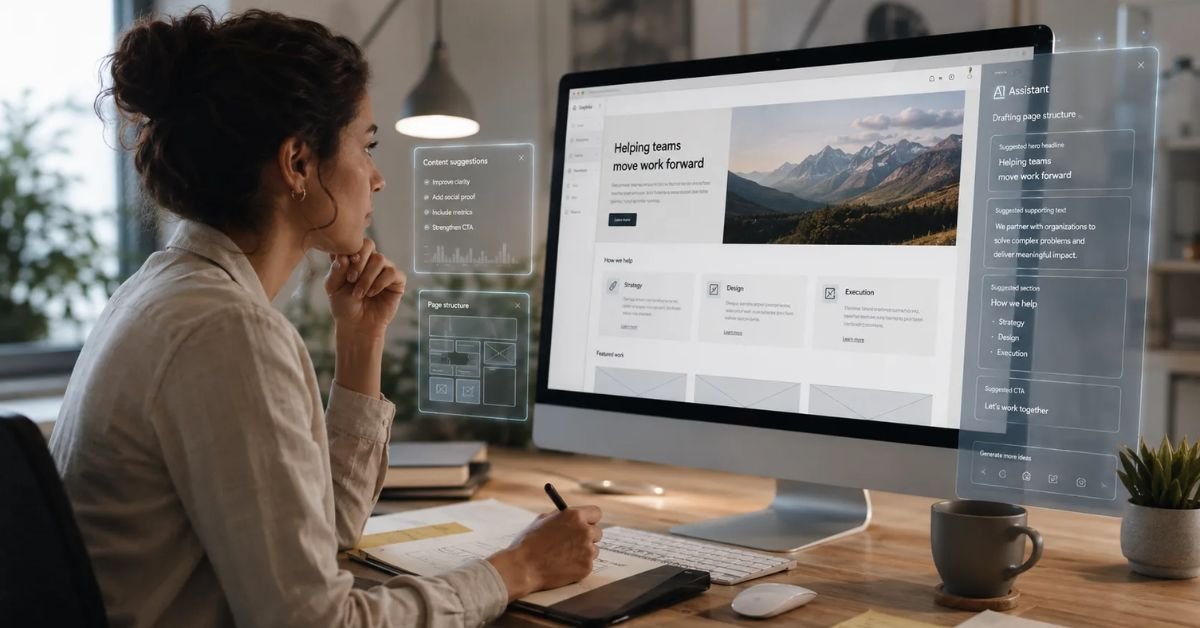
An AI website builder uses artificial intelligence to simplify website creation. Instead of manually designing every section, users can describe their requirements and allow the platform to generate a website.
For example, you could enter a prompt such as:
“Create a professional website for a digital marketing agency offering SEO, PPC advertising, social media marketing, and content marketing.”
The AI may generate a website structure containing:
- Homepage
- About section
- Services
- Testimonials
- Contact form
- Call-to-action buttons
- Images
- Navigation
- Footer
You can then modify the generated website using a visual editor.
Most AI website builders are designed for users who want to create websites without writing code.
What Is WordPress?
WordPress is a widely used content management system that allows users to create and manage websites.
Unlike many hosted AI website builders, WordPress gives users significant control over the website’s hosting environment, themes, plugins, files, database, and functionality.
WordPress can be used to build:
- Blogs
- Business websites
- Ecommerce stores
- News websites
- Membership websites
- Online courses
- Affiliate websites
- Portfolio websites
- Large content websites
WordPress can be simple for beginners, but advanced customization often requires more technical knowledge.
AI Website Builder vs WordPress: Key Difference
The biggest difference is the approach to website creation.
An AI website builder tries to automate much of the process.
You provide information about your business and requirements, and AI creates a starting website.
WordPress gives you a framework and ecosystem where you choose the theme, plugins, hosting, design, content structure, and functionality.
In simple terms:
AI website builder: Faster and easier.
WordPress: More flexible and customizable.
Neither option is automatically better for every website.
Ease of Use
Ease of use is one of the biggest differences between the two platforms.
AI Website Builders
AI website builders are generally designed for beginners.
You can often create a website by answering questions or writing a prompt.
AI can generate the initial layout, text, images, and sections.
Visual editors allow you to make changes without touching code.
This makes AI website builders particularly useful for:
- Beginners
- Small businesses
- Freelancers
- Entrepreneurs
- Marketers
- Local businesses
WordPress
WordPress can also be beginner-friendly, but there are more components to understand.
You may need to manage:
- Hosting
- Themes
- Plugins
- Updates
- Backups
- Security
- Performance
- Website settings
Basic WordPress websites are not necessarily difficult to create, but building a highly customized website can require more technical knowledge.
Winner for ease of use: AI website builders
Website Design and Customization
Design flexibility is another important consideration.
AI Website Builders
AI can create attractive layouts quickly.
You can usually modify:
- Colors
- Fonts
- Images
- Sections
- Buttons
- Spacing
- Navigation
- Page layouts
However, some platforms may limit advanced customization.
If you need a highly unusual layout or custom functionality, you may eventually run into platform limitations.
WordPress
WordPress provides a much larger customization ecosystem.
You can choose from thousands of themes and plugins and create highly customized layouts.
Developers can also modify themes, add custom code, create custom plugins, and change website functionality.
This makes WordPress particularly useful for businesses that expect their website requirements to become more advanced over time.
Winner for customization: WordPress
SEO Comparison

SEO is one of the most important factors when comparing an AI website builder vs WordPress.
Both can be used to create SEO-friendly websites.
The platform itself does not guarantee Google rankings.
SEO With AI Website Builders
Modern AI website builders can provide many useful SEO features, including:
- Page titles
- Meta descriptions
- Custom URLs
- Image alt text
- Responsive layouts
- Sitemaps
- Analytics integration
- Basic structured data
- SEO recommendations
AI can also help generate content, keyword ideas, FAQs, page titles, and meta descriptions.
For beginners, this can make SEO easier to manage.
SEO With WordPress
WordPress provides extensive SEO flexibility.
Users can install SEO plugins and customize many aspects of on-page and technical SEO.
You can manage:
- Titles
- Meta descriptions
- Canonical URLs
- XML sitemaps
- Schema markup
- Redirects
- Robots.txt
- Internal linking
- Content structure
- Image optimization
WordPress is especially powerful for content-heavy websites.
If SEO is a major part of your long-term strategy and you want maximum control, WordPress generally offers more flexibility.
Winner for advanced SEO control: WordPress
Winner for beginner-friendly SEO: AI website builders
Content Management
Content management is particularly important for bloggers, publishers, affiliate websites, and businesses that plan to publish frequently.
AI Website Builders
Many AI website builders include blogging features, but the depth of those features varies.
They can be perfectly suitable for small blogs and business websites.
AI also makes content creation easier by helping generate:
- Article outlines
- Blog posts
- FAQs
- Product descriptions
- Headlines
- Meta descriptions
WordPress
WordPress was originally built around content publishing and remains a strong choice for content-heavy websites.
It provides extensive control over:
- Categories
- Tags
- Posts
- Pages
- Authors
- Media
- Archives
- Custom post types
For websites publishing hundreds or thousands of articles, WordPress can provide a more flexible content management environment.
Winner for content-heavy websites: WordPress
AI Content Creation
AI website builders have an advantage when it comes to integrated AI assistance.
You can ask AI to:
- Write website copy
- Rewrite paragraphs
- Create headlines
- Generate FAQs
- Create service descriptions
- Suggest CTAs
- Create page sections
WordPress can also use AI through plugins and external tools.
The difference is that AI is often more deeply integrated into newer AI-first website builders.
However, regardless of platform, AI-generated content should be reviewed before publishing.
Content should be accurate, useful, original, and relevant to the target audience.
Performance and Website Speed
Website performance affects user experience and can influence SEO.
AI Website Builders
Hosted AI website builders typically manage the technical infrastructure for you.
You do not usually need to configure the server yourself.
This can make website performance easier to manage for beginners.
However, you have less control over the underlying hosting environment.
WordPress
WordPress performance depends heavily on:
- Hosting
- Theme
- Plugins
- Images
- Scripts
- Caching
- Database optimization
- CDN configuration
A well-optimized WordPress website can be extremely fast.
A poorly configured WordPress website can become slow.
Therefore, WordPress gives you more control but also places more responsibility on you.
Winner for simplicity: AI website builders
Winner for performance control: WordPress
Security
Security is another major consideration.
AI Website Builders
Hosted AI website builders usually manage much of the technical infrastructure.
The provider typically handles platform-level updates and security measures.
This reduces the number of technical tasks users need to manage.
WordPress

With WordPress, security depends partly on your hosting environment, themes, plugins, configuration, and maintenance.
You need to keep software updated and use trusted plugins and themes.
Security tools, backups, firewalls, and monitoring can also be added.
WordPress is not inherently unsafe, but it requires more maintenance because of its open and customizable ecosystem.
Winner for hands-off security management: AI website builders
Ecommerce
Both options can be used for ecommerce, but the best choice depends on the store’s complexity.
AI Website Builders for Ecommerce
AI can help generate:
- Product pages
- Product descriptions
- Store layouts
- Promotional sections
- Landing pages
- Category pages
This can be useful for small online stores.
WordPress for Ecommerce
WordPress can be combined with ecommerce solutions to create highly customizable online stores.
You can customize:
- Product pages
- Checkout
- Payment systems
- Shipping
- Product categories
- Discounts
- Customer accounts
- Marketing integrations
For advanced ecommerce projects, WordPress can provide more flexibility.
Winner for advanced ecommerce customization: WordPress
Cost Comparison
Cost is not always straightforward because both options can have different pricing structures.
AI Website Builder Costs
Many AI website builders use subscription plans.
A plan may include:
- Hosting
- Website builder
- AI tools
- Templates
- SSL
- Support
- Domain-related features
This makes costs easier to predict.
WordPress Costs
WordPress software itself can be available without a software license fee, but you generally need hosting and may pay for:
- Premium themes
- Premium plugins
- Domain
- Hosting
- Security tools
- Backup services
- Developer support
WordPress can be inexpensive for a basic website but can also become expensive as you add premium tools and services.
Winner for predictable pricing: AI website builders
Winner for flexibility in budget: WordPress
Scalability
Scalability means the ability to grow your website as your requirements change.
AI Website Builders
AI website builders can be excellent for small and medium-sized websites.
They are particularly suitable for:
- Business websites
- Landing pages
- Portfolios
- Service websites
- Small blogs
However, advanced websites may eventually need functionality that a specific platform does not support.
WordPress
WordPress is highly flexible and can support everything from a small blog to a large content platform.
You can add new functionality through plugins, custom development, integrations, and hosting upgrades.
For businesses expecting significant growth and customization, WordPress can be a strong long-term choice.
Winner for flexibility and scalability: WordPress
Maintenance
Maintenance is often overlooked when choosing a website platform.
AI Website Builder Maintenance
Most technical maintenance is handled by the platform provider.
You generally focus on:
- Updating content
- Changing designs
- Managing pages
- Reviewing analytics
This makes AI website builders convenient.
WordPress Maintenance
WordPress requires more regular maintenance.
You may need to:
- Update WordPress
- Update plugins
- Update themes
- Monitor security
- Create backups
- Check compatibility
- Optimize performance
For businesses without technical staff, this additional responsibility can be a disadvantage.
Winner for low maintenance: AI website builders
AI Website Builder vs WordPress for Beginners
If you have never built a website before, an AI website builder is usually easier.
You can describe what you want and receive a working starting point.
For example:
“Create a modern website for a local plumbing company with service pages, testimonials, contact information, emergency service CTA, and a booking form.”
The AI can create the initial structure.
WordPress requires you to make more decisions before the website is ready.
You may need to choose:
- Hosting
- Theme
- Plugins
- Page builder
- Security tools
- Backup system
For someone who simply wants to get a website online quickly, AI can reduce the learning curve.
AI Website Builder vs WordPress for SEO
For basic SEO, both options can work well.
The more important question is how much control you need.
Choose an AI website builder if you want:
- Simple SEO settings
- AI-assisted content
- Easy page creation
- Automated technical management
- Minimal maintenance
Choose WordPress if you want:
- Advanced SEO customization
- Large content libraries
- Extensive plugin options
- Custom schema
- Detailed technical control
- Complex content structures
A WordPress website does not automatically rank higher than an AI-built website.
Likewise, an AI website builder does not automatically provide better SEO.
Content quality and SEO strategy remain more important than the platform alone.
Which Is Better for Small Businesses?

For a small business that needs a professional website quickly, an AI website builder can be a practical choice.
A local business may only need:
- Homepage
- About page
- Services
- Testimonials
- Contact page
- Location information
- Lead form
An AI builder can create this type of website quickly.
WordPress becomes more attractive when the business needs advanced blogging, ecommerce, integrations, booking systems, custom functionality, or a larger content strategy.
Which Is Better for Bloggers and Affiliate Websites?
For content-heavy websites, WordPress generally has an advantage.
Bloggers and affiliate marketers often need:
- Large content libraries
- Categories
- Tags
- Internal linking
- SEO plugins
- Custom templates
- Affiliate link management
- Advanced analytics
WordPress provides extensive control for these workflows.
An AI website builder can still work for smaller blogs, but WordPress is usually more suitable when content publishing is the core purpose of the website.
Which Is Better for Ecommerce?
For a simple ecommerce website, an AI-powered platform can make setup easier.
For a complex store with advanced product management, custom checkout requirements, integrations, and extensive customization, WordPress may be more suitable.
The decision should be based on the size and complexity of your store rather than simply choosing the newest AI technology.
AI Website Builder vs WordPress: Pros and Cons
AI Website Builder Pros
- Easy to use
- Fast website creation
- No coding required
- AI-generated designs
- AI content assistance
- Hosted infrastructure
- Lower technical maintenance
- Beginner-friendly
AI Website Builder Cons
- Less control over infrastructure
- Platform limitations
- Possible migration challenges
- Advanced customization may be restricted
- Features vary between providers
WordPress Pros
- Highly customizable
- Large plugin ecosystem
- Extensive theme selection
- Strong content management
- Advanced SEO flexibility
- Suitable for complex websites
- Strong ecommerce options
- Greater control over hosting
WordPress Cons
- More maintenance
- More technical decisions
- Plugin compatibility issues can occur
- Security requires attention
- Performance optimization may require technical knowledge
Which One Should You Choose in 2026?
The answer depends on your website goals.
Choose an AI website builder if you want to:
- Launch quickly
- Avoid coding
- Reduce technical maintenance
- Create a simple business website
- Use AI for design and content
- Build landing pages
- Start with minimal technical knowledge
Choose WordPress if you want to:
- Build a content-heavy website
- Have extensive customization
- Run a large blog
- Build a complex ecommerce store
- Use advanced SEO tools
- Add custom functionality
- Control hosting and website files
- Scale into a more complex website
Must Read:
- Best AI Website Builders for SEO in 2026
- Can AI Build an SEO-Friendly Website That Ranks on Google?
- How to Build a Landing Page With AI Without Coding?
Final Verdict:
So, AI Website Builder vs WordPress: which is better in 2026?
There is no universal winner.
An AI website builder is the better choice when speed, simplicity, automation, and low maintenance are your priorities. It is particularly useful for beginners, small businesses, freelancers, landing pages, and straightforward websites.
WordPress is the stronger option when flexibility, customization, content management, advanced SEO, ecommerce, and long-term control are more important.
If your goal is to create a professional website quickly without coding, start with an AI website builder. If you expect to publish a large amount of content, require advanced customization, or want complete control over your website ecosystem, WordPress may be the better long-term choice.
The most important factor is not whether a website was built using AI or WordPress. What matters is whether the website provides useful content, offers a good user experience, loads efficiently, works well on mobile devices, and gives visitors a clear reason to stay and take action.
In 2026, both AI website builders and WordPress can be excellent choices. The best platform is the one that matches your technical skills, business goals, SEO strategy, budget, and future plans.